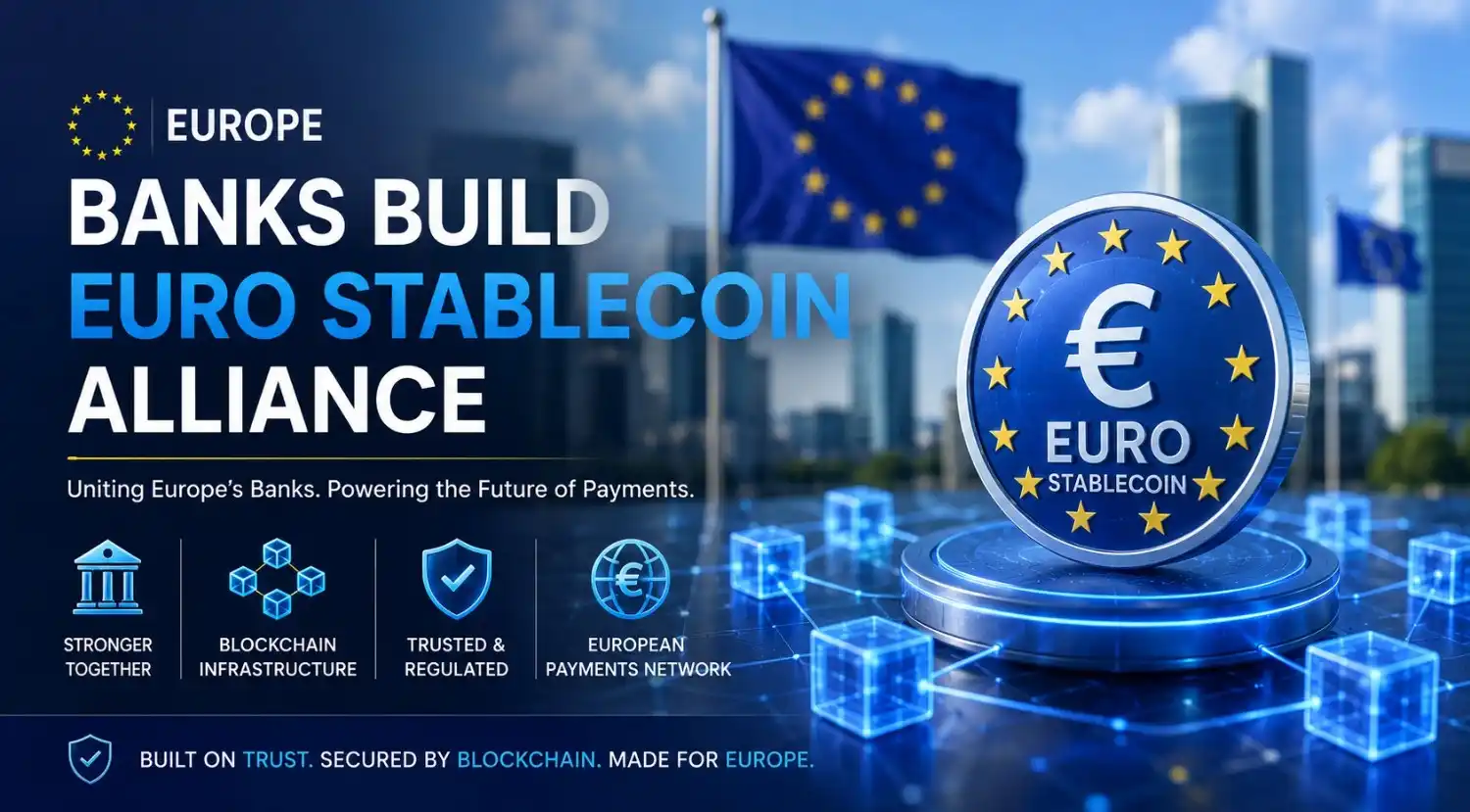
For two years, the question hovering over European finance has been when — not whether — major banks would commit seriously to stablecoins. As of May 2026, the answer is now clear. Qivalis, a Dutch-regulated joint venture incorporated by twelve of Europe’s most important banks, is preparing to launch a fully MiCAR-compliant euro-pegged stablecoin in the second half of this year. The coalition includes BBVA, BNP Paribas, ING, UniCredit, CaixaBank, Danske Bank, KBC, SEB, and others — and as of this week, Banco Sabadell and Bankinter are confirmed as the next wave of signatories, with Abanca, Kutxabank, and Cecabank also expected to join.
This is one of the strongest signals so far that traditional finance has moved past the experimentation phase on blockchain. The Qivalis consortium isn’t a sandbox project or an internal pilot. It is a regulated joint venture, capitalized by some of Europe’s largest balance sheets, building rails intended to compete directly with USDT and USDC for global digital payments. Here’s what the structure looks like, why the banks are moving now, and what’s actually at stake.
What Qivalis Is, and How It’s Structured
Qivalis was formally incorporated on 2 December 2025 in Amsterdam by an initial group of ten European banks, with two more — including BBVA — joining shortly after. The current twelve-member core consortium consists of:
- Banca Sella (Italy)
- BBVA (Spain)
- BNP Paribas (France)
- CaixaBank (Spain)
- Danske Bank (Denmark)
- DekaBank (Germany)
- DZ BANK (Germany)
- ING (Netherlands)
- KBC (Belgium)
- Raiffeisen Bank International (Austria)
- SEB (Sweden)
- UniCredit (Italy)
That list represents roughly the spine of European retail and commercial banking. According to reporting by Reuters, Expansión, and Bankless Times, the second wave joining now includes Sabadell and Bankinter (Spain’s fourth- and fifth-largest banks), with Abanca, Kutxabank, and Cecabank also expected to be announced in the coming weeks.
Structurally, Qivalis is operating under three important architectural choices:
Domicile and regulation. The joint venture is headquartered in Amsterdam and is pursuing an Electronic Money Institution (EMI) licence from De Nederlandsche Bank (the Dutch Central Bank). This places it squarely under the EU’s Markets in Crypto-Assets Regulation (MiCAR) — the bloc’s comprehensive crypto rulebook, fully in force since late 2024.
Reserve backing. The stablecoin will be backed 1:1 by reserves, with at least 40% held in bank deposits and the remainder in high-quality euro-area government bonds. This is meaningfully more conservative than the typical commercial-paper-heavy reserve composition that dogged Tether’s reputation in earlier years, and it’s structured for regulatory comfort rather than yield optimization.
Technical infrastructure. Custody and tokenization technology is being provided by Fireblocks, the New York-based digital asset infrastructure firm that already powers significant institutional crypto activity. Fireblocks is handling the technical work alongside the consortium’s regulatory process.
The commercial launch is slated for the second half of 2026, once the technical and regulatory work is complete.
Why Now: The Dollar Stablecoin Problem
The strategic context for Qivalis is impossible to understand without one specific number: the global stablecoin market hit $305 billion in January 2026, and 99% of that volume is dollar-denominated. Euro-pegged stablecoins represented just $650 million — a rounding error in the market.
That asymmetry has become a serious concern in European policy circles. The euro is the second-most-traded currency in the world, accounting for nearly $1.1 trillion in daily volume. Yet in the digital asset economy — in on-chain settlement, in crypto exchanges, in tokenized commerce — the euro is essentially absent. USDT (Tether) and USDC (Circle) dominate global crypto payments. Every time a European business or consumer transacts on-chain in dollar stablecoins, that’s effective monetary territory ceded to the United States.
Qivalis is, transparently, a response to this. Multiple member banks have framed the project explicitly as a way to counter US dominance in digital payments. CEO of Sabadell, Cesar Gonzalez-Bueno, told a press conference this week that the consortium is “primarily designed to make transactions more efficient and secure. It is a European project that we believe makes sense, and we will indeed be part of it.” That’s a politely diplomatic version of a strategically harder argument: if Europe wants its currency to matter in the next financial era, it cannot leave the digital rails to American issuers.
Why Banks, Specifically, Rather Than a Fintech
There’s a deeper question worth sitting with: why is this being built by an alliance of incumbent banks rather than by Circle, a fintech, or a public-private partnership with the European Central Bank?
Three reasons converge:
Regulatory comfort. A bank-backed, MiCAR-compliant stablecoin issued by an EMI under Dutch supervision is, from a European regulator’s perspective, something far closer to a known quantity than a Silicon Valley fintech-issued token. The reserve composition (40%+ in bank deposits, the rest in euro-area government bonds) is built for that supervisory comfort.
Distribution. Stablecoins are network-effect products — they only work if you can spend them somewhere. By embedding Qivalis directly inside the channels of twelve major banks (and growing), the consortium gets immediate access to online banking, merchant acquiring, and treasury tools across multiple European markets. A fintech would need years to build the equivalent reach.
Defensive positioning. Stablecoins are increasingly seen by traditional banks as a competitive threat to their core deposit and payments franchise. If you’re a major bank, you’d rather own the stablecoin rails than be disintermediated by them. Qivalis converts a competitive threat into a coordinated commercial opportunity — and it does so as a shared infrastructure play, where no single bank bears the full development cost or risk.
The MiCAR Advantage
The European regulatory framing is decisive here. Under MiCAR, which came into full force in late 2024, stablecoin issuers must hold reserves on a 1:1 basis, must be authorized as either Electronic Money Institutions or credit institutions, and face strict transparency and redemption requirements. Issuers operating from outside the EU face significant restrictions when serving European customers.
For Qivalis, MiCAR isn’t a hurdle — it’s a moat. By being MiCAR-native from day one, the consortium operates within a regulatory framework that constrains its competitors. Tether’s USDT, in particular, has had a fraught relationship with European regulators. USDC’s Circle has navigated the rules more carefully but still operates on a fundamentally American regulatory base. A euro stablecoin issued by a Dutch-licensed EMI, backed by twelve EU-supervised banks, sits in a regulatory category neither US issuer can easily replicate.
What Sabadell and Bankinter Joining Actually Means
This week’s news that Sabadell and Bankinter — Spain’s fourth- and fifth-largest banks — are joining Qivalis is meaningful for two reasons.
First, it gives Spain four seats at the table (BBVA, CaixaBank, Sabadell, Bankinter), which is a heavyweight presence for a single national market and reflects how far Spanish banking has moved on digital asset infrastructure.
Second, it signals that the consortium is moving from the “founding cohort” to the “broad coalition” phase. Mid-sized banks plugging into shared digital euro rails — rather than building their own tokenization stacks — is exactly the dynamic Qivalis is designed to catalyze. Once a critical mass of banks distribute the same stablecoin through their channels, network effects begin to take hold.
The consortium is reportedly already in advanced talks with crypto exchanges and liquidity providers about listing and market-making, so the coin will have depth from launch day rather than building it slowly post-launch. That’s important: stablecoins live or die on liquidity, and a euro stablecoin that doesn’t have deep on-exchange order books at launch will struggle to capture the use cases that dollar stablecoins currently dominate.
What This Means for the Broader Picture
Step back from the press releases, and what’s happening here is a structural shift. Twelve of Europe’s largest banks have decided — collectively, jointly, and on the public record — that blockchain rails are part of their core infrastructure roadmap, not a side experiment. The Qivalis stablecoin won’t be the only thing it enables: member banks expect to use the rails for on-chain settlement, tokenized asset services, and faster interbank euro payments, in addition to merchant and consumer payment use cases.
This is the moment when “stablecoin” stops being a crypto-native term and becomes part of normal banking vocabulary. It’s also the moment when European monetary policy starts having to take seriously what private-sector digital euros mean alongside the European Central Bank’s own digital euro project, which has been moving slowly through preparation phases.
For dollar stablecoins, Qivalis is unlikely to dethrone USDT and USDC overnight — the dollar’s lead is enormous. But it does represent the first credible institutional alternative on a major-economy scale. If Qivalis launches successfully in the second half of 2026 and gets adoption inside the channels of twelve major banks, it will materially change the geographic distribution of stablecoin volume for the first time since the category emerged.
What to Watch Next
The near-term inflection points are concrete:
The Dutch Central Bank’s EMI licensing decision. This is the regulatory gate. Qivalis cannot launch without it, and the timing of its issuance will set the actual launch date.
The official announcement of new members. Reuters reports an announcement expected “in the coming weeks” for the second wave including Sabadell, Bankinter, Abanca, Kutxabank, and Cecabank.
Exchange listings and liquidity arrangements. The depth of day-one liquidity will determine whether Qivalis becomes a usable trading pair or a slowly adopted novelty.
The competitive response. Watch for moves from Société Générale (whose Forge subsidiary already issues a euro stablecoin called EURCV) and from any potential American push to ensure USDC remains accessible inside MiCAR.
The ECB’s stance. The European Central Bank has been working on a digital euro for years. A successful private-sector euro stablecoin from twelve major banks is going to force the ECB to articulate, more clearly than it has so far, what role public-sector digital currency should play alongside private bank-issued stablecoins.
The Bottom Line
The Qivalis consortium represents the moment Europe’s largest banks decided that stablecoins are too important to leave to fintechs and Americans. With the second wave including Sabadell and Bankinter, now confirmed, and a MiCAR-compliant launch slated for late 2026, the project moves from concept into deployment. Whether it succeeds in challenging dollar dominance is uncertain. That it represents a structural commitment by traditional European finance to blockchain infrastructure is no longer in doubt.