
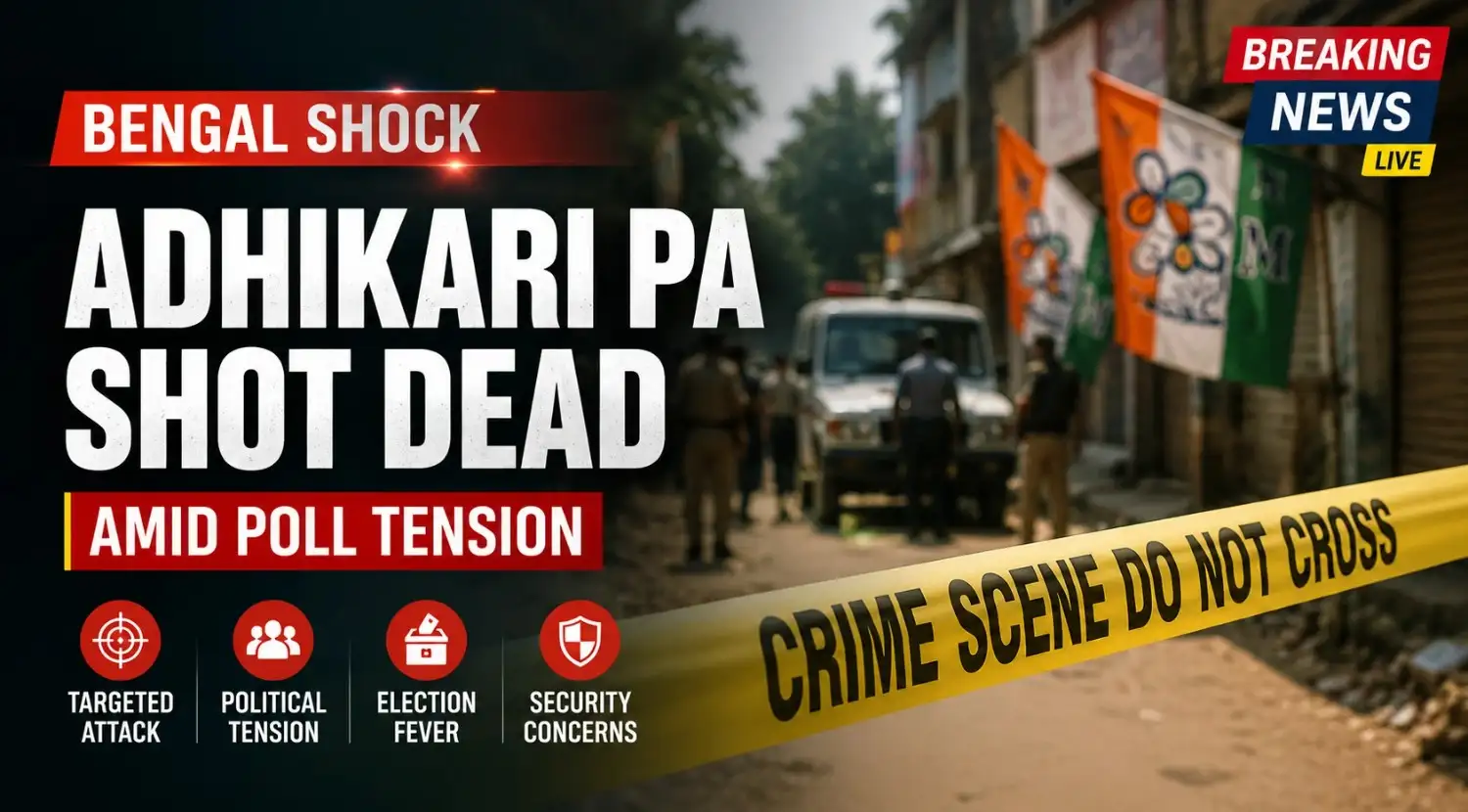
West Bengal, still reeling from one of the most dramatic political verdicts in its modern history, has been rocked by a chilling act of violence. Chandranath Rath, the personal assistant of BJP leader and Leader of Opposition Suvendu Adhikari, was shot dead in Madhyamgram in North 24 Parganas district on the night of Wednesday, May 6, 2026, barely 48 hours after the BJP’s landslide victory ended the Trinamool Congress’s 15-year rule in the state.
The killing has sent shockwaves through Bengal’s political establishment, escalating an already volatile post-poll atmosphere and triggering serious questions about law and order during a fragile transition of power.
What Happened in Madhyamgram
According to police and party sources, Chandranath Rath was returning home late Wednesday night when his Scorpio vehicle was ambushed roughly 200 metres from his Madhyamgram residence. Investigators believe the attack was carefully planned. Initial findings suggest that as many as eight assailants travelling on four motorcycles were involved in the operation.
Eyewitnesses say another car intercepted Rath’s vehicle on the road. As his Scorpio slowed down, the bike-borne attackers opened fire at close range. Reports indicate that the gun was pressed against the car window, and three rounds were discharged at point-blank range. Rath sustained multiple bullet injuries and was rushed to a private hospital, where doctors declared him dead.
The attackers fled the scene immediately. As of the latest reports, no arrests had been made.
Who Was Chandranath Rath?
Within BJP circles in Bengal, Chandranath Rath was widely known as Suvendu Adhikari’s “shadow.” He served as the executive assistant to the Leader of Opposition in the West Bengal Assembly and was one of Adhikari’s most trusted aides, accompanying him to political meetings, managing constituency work, and acting as a bridge between the leader and grassroots cadres.
What makes his killing particularly grim is the context of his final hours. Rath had reportedly travelled to his native Chandipur village in East Midnapore after the BJP’s victory and had spent much of Wednesday urging local BJP workers to maintain peace. According to party colleagues, he had been telling cadres, “Dada has requested you all to stay calm and not indulge or resort to any violence.” Hours after delivering that message of restraint, he was dead.
The irony has not been lost on his colleagues, who describe his murder as a “cold-blooded” assassination of a peacemaker.
Suvendu Adhikari’s Reaction
News of the attack spread rapidly across the state. A large crowd gathered outside the hospital, and several senior BJP leaders, including Sukanta Majumdar, Arjun Singh, Shankar Ghosh, Piyush Kanoria, Kaustav Bagchi, and BJP vice-president Raju Banerjee, rushed to the spot.
Suvendu Adhikari himself arrived at the hospital shortly after midnight under heavy security cover. Visibly shaken, he termed the incident a “cold-blooded murder” and alleged that Rath had been deliberately targeted. He demanded strict and immediate action against those responsible.
Adhikari’s emotional response carried added weight given that he is widely tipped to become the next Chief Minister of West Bengal following the BJP’s historic win. The killing of his closest aide, on the eve of his expected swearing-in, has injected a deeply personal dimension into what was already a tense political moment.
A Conspiracy to Kill Suvendu? BJP Raises the Stakes
BJP leaders have not minced words. Rajya Sabha MP Rahul Sinha alleged that the attack was, in fact, part of a larger conspiracy to assassinate Suvendu Adhikari himself, with Rath becoming a victim of that plot. Newly elected BJP MLA Tarunjyoti Tewari accused the TMC of having “made the biggest blunder,” signalling that the party intends to keep political pressure on the outgoing government.
These accusations remain allegations at this stage. Police officials say CCTV footage from the surrounding area is being analysed, and an investigation is underway to identify the attackers and establish a motive. The motive behind the killing has not yet been officially determined.
Part of a Wider Wave of Post-Poll Violence
The shooting of Chandranath Rath is not an isolated incident. It comes amid a disturbing pattern of post-election violence sweeping through West Bengal since results were declared on May 4, 2026.
Earlier on Tuesday, a BJP worker was reportedly killed in the Rajarhat-Newtown assembly constituency, with the BJP accusing frustrated TMC supporters of being behind the murder. Reports also indicate that two BJP workers and one TMC worker have lost their lives in post-poll violence across the state, with vandalism reported in multiple areas.
Hours after Rath’s killing, another incident was reported from Basirhat in North 24 Parganas, where BJP worker Rohit Roy, alias Chintu, was shot during a clash over the placement of BJP flags. He was rushed to Basirhat state-run hospital, but later reports confirmed that he had succumbed to his injuries.
The BJP has alleged that “TMC-sheltered miscreants” are behind much of the violence. The TMC, in turn, has accused the BJP of orchestrating attacks on its workers and has alleged that BJP-linked groups are impersonating TMC cadres to discredit the outgoing ruling party. Both sides have publicly appealed for peace, but on the ground, tensions continue to escalate.
Why This Killing Matters Politically
Three factors make Chandranath Rath’s murder a watershed moment in Bengal’s post-election story.
First, the proximity to Suvendu Adhikari. Targeting the personal assistant of the man poised to become the next Chief Minister is, regardless of motive, an audacious act. It raises immediate questions about the security environment around the BJP’s top leadership during the transition phase.
Second, the timing. The killing occurred during what is constitutionally meant to be a smooth handover, and at a moment when outgoing CM Mamata Banerjee has refused to resign and is publicly disputing the election mandate. The political temperature was already at the boiling point; this incident has poured fuel on it.
Third, the symbolism. Rath died hours after appealing for peace. His killing undermines any narrative that the situation in Bengal is normalising, and it provides the BJP with powerful political ammunition to demand central intervention, deployment of additional security forces, or even President’s Rule in pockets where violence is concentrated.
The Investigation Ahead
Police have launched a full-scale investigation. CCTV footage is being examined, eyewitnesses are being questioned, and senior officers are reportedly monitoring the case closely. The fact that an estimated eight assailants on four motorcycles allegedly executed a planned ambush suggests organised criminal involvement rather than a spontaneous act.
Whether the killing was politically motivated, personally motivated, or part of a larger conspiracy, as the BJP alleges, will depend on what the investigation uncovers in the coming days. For now, no arrests have been confirmed.
A Test for the New Bengal
Chandranath Rath’s death is more than a single tragic killing. It is a stress test for West Bengal’s political institutions at a defining moment. The state is poised to inaugurate a new government, possibly under Suvendu Adhikari himself, while simultaneously confronting its old demons of post-poll violence, a recurring shadow over Bengal’s electoral history.
How the police investigate, how the courts respond, how the incoming and outgoing governments behave, and how political parties choose to channel their anger will determine whether this killing becomes a turning point toward accountability or just another grim entry in Bengal’s long ledger of political violence.
For Suvendu Adhikari, who lost a man he treated as family, the moment is both deeply personal and profoundly political. For the people of Bengal, it is a sobering reminder that the verdict on May 4 may have ended one chapter, but the next one is far from peaceful.