For most of the past decade, artificial intelligence and blockchain were treated as rivals for attention two buzzwords competing for headlines, funding, and developer talent. AI was about intelligence. Blockchain was about trust. They lived on parallel tracks and rarely touched.
In 2026, those tracks have merged. AI and blockchain are no longer two separate conversations. They have converged into a single force that is reshaping how applications are built, how data is owned, how machines transact, and how we know what is real online. Industry observers increasingly describe this fusion not as a passing trend but as the foundation of the next internet a web that is intelligent, verifiable, autonomous, and owned by its users.
This article explains why these two technologies fit together so naturally, what they are building when combined, and the hard problems that still stand between the vision and the reality.
Why AI and Blockchain Need Each Other
The convergence is not accidental hype. It is the logical result of two technologies that solve each other’s deepest weaknesses.
Think about what each one lacks. AI is powerful but opaque. It makes decisions through processes humans cannot easily inspect, it can be manipulated, and it offers no built-in way to prove that an output is genuine or that a model behaved as claimed. Blockchain, meanwhile, is trustworthy but not intelligent. It can verify, record, and settle with cryptographic certainty but it cannot reason, recognise patterns, or adapt.
Put them together and the gaps close. As one technical guide put it, blockchain provides what AI lacks transparency, verifiability, and decentralised trust while AI provides what blockchain lacks adaptability, pattern recognition, and intelligent decision-making.
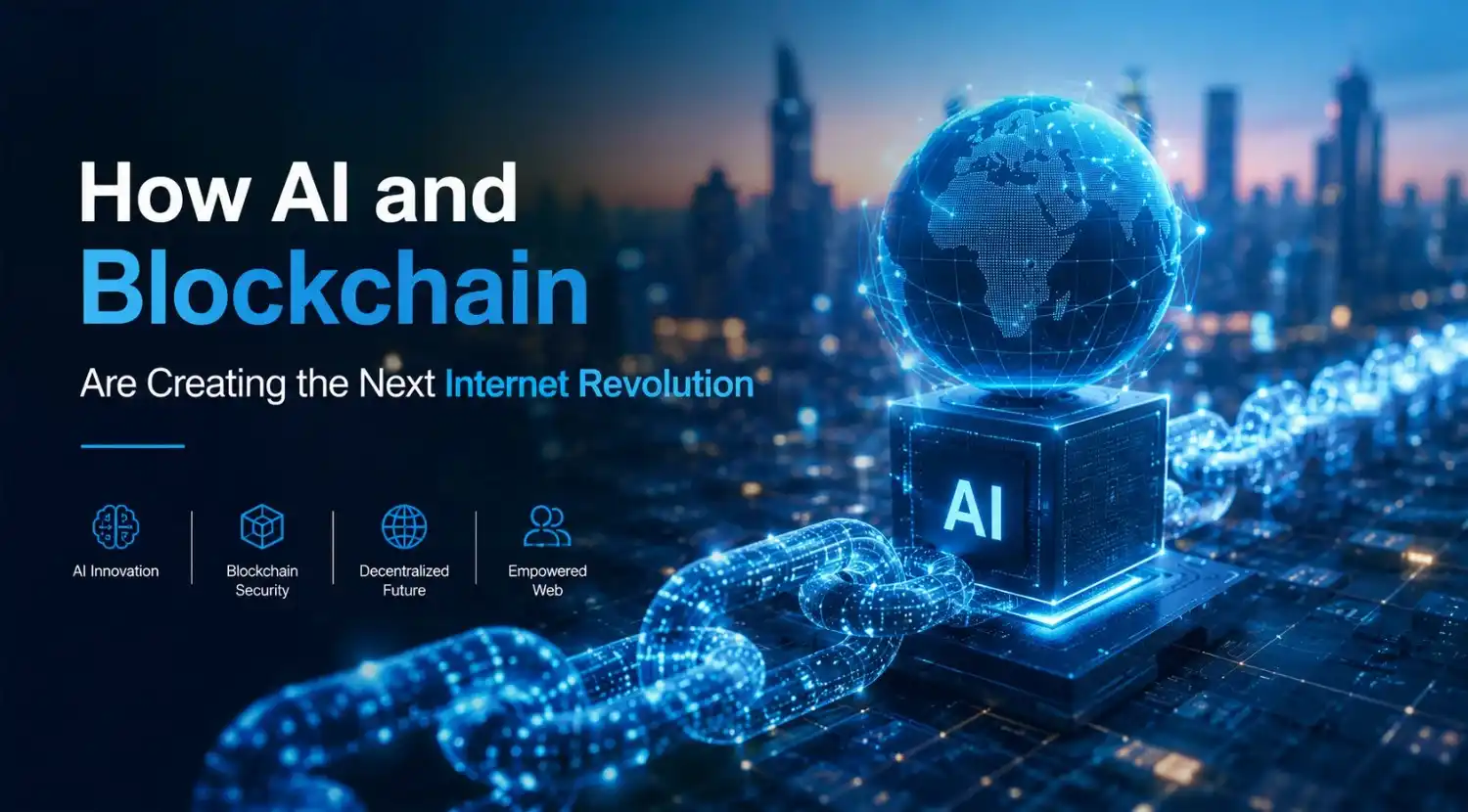
That complementarity is the entire thesis of the next internet. AI makes the system smart. Blockchain makes it trustworthy. Neither alone can deliver an internet that is both.
What Made the Convergence Possible in 2026
A few specific breakthroughs turned this from theory into working infrastructure.
First, large language models became genuinely capable with blockchain code. LLMs now understand programming languages like Solidity, Rust, and Move well enough to generate, audit, and optimise smart contracts with meaningful accuracy. Their training data now includes millions of deployed contracts, audit reports, and exploit postmortems giving them deep contextual understanding of blockchain-specific vulnerabilities.
Second, on-chain compute became viable. Specialised Layer 2 networks and verifiable computation frameworks now make it practical to run or verify AI workloads with blockchain-grade trust guarantees.
Third, the infrastructure matured underneath both. Layer 2 networks have slashed transaction costs, interoperability protocols let different blockchains communicate, and account abstraction plus zero-knowledge proofs have made the underlying complexity nearly invisible to users.
That last point matters enormously. By 2026, the technology is becoming so seamless that users may not even know they are interacting with a blockchain at all replacing 24-word seed phrases with biometrics and social recovery. As the saying goes, when technology becomes invisible, it has finally succeeded.
The Building Blocks of the Next Internet
So what are AI and blockchain actually building together? Several distinct categories have emerged.
Intelligent, Self-Improving Smart Contracts
Traditional smart contracts execute predefined logic deterministically rigid, and blind to anything outside their code. AI-enhanced smart contracts change that. They can adapt to real-world data, optimise outcomes based on live analytics, and respond intelligently to changing conditions. A DeFi lending contract powered by AI can dynamically adjust collateral requirements based on real-time volatility, all while the blockchain guarantees the execution is tamper-proof and auditable.
Decentralised AI Infrastructure
One of the fastest-growing areas of Web3 is decentralised AI an attempt to break Big Tech’s grip on the technology. Networks like Bittensor let independent contributors share computing power and AI models on a blockchain-based network where nobody owns the system and the best models are rewarded with tokens. Projects like Render tackle GPU scarcity one of AI’s most immediate bottlenecks by coordinating distributed compute. The promise is access to powerful AI without being locked into a handful of corporate cloud providers.
Autonomous AI Agents With Wallets
This may be the most transformative category. AI agents autonomous software that pursues goals are increasingly being given blockchain wallets and identities. That lets them transact, hold assets, and operate independently. The next frontier is agent-to-agent commerce: autonomous systems that negotiate, transact, and maintain state across multiple blockchains without human involvement. Some analysts have called 2026 “the year the agents take over.” Blockchain gives these agents something they critically need a verifiable identity, an auditable transaction history, and a trust layer for dealing with other agents.
Content Authenticity and Provenance
Here AI and blockchain solve a problem AI itself created. Deepfakes, synthetic media, and AI-generated misinformation are flooding the internet, and it is getting harder to know if a photo, video, or article is real. Blockchain offers an elegant fix: by recording the origin and ownership of digital content on-chain at the moment of creation, you produce a permanent, tamper-proof certificate of authenticity. In a world saturated with synthetic content, on-chain provenance becomes essential infrastructure for trust.
Smarter Decentralised Governance
DAOs decentralised autonomous organisations are maturing, and AI is accelerating that. AI-assisted governance tools now analyse the likely impact of proposals and flag risks before communities vote. Combined with more sophisticated voting systems and legal wrappers that let DAOs sign contracts and own assets, this is making decentralised governance credible enough to attract serious institutional participation.
Verifiable Enterprise AI
For businesses, the combination addresses a real anxiety. As one enterprise Web3 strategist put it, organisations deploying AI without blockchain-grade auditability are building on sand and in 2026, the most competitive enterprises will run AI agents on verifiable, on-chain rails. When an AI makes a consequential business decision, blockchain provides the immutable audit trail that regulators, auditors, and customers increasingly demand.
The Bigger Picture: From Speculation to Utility
What makes 2026 different from earlier crypto cycles is a fundamental change in the industry’s character. After years of speculative excess, Web3 has shifted decisively from “crypto for the sake of crypto” to “blockchain solving real problems.”
This convergence sits alongside two other maturing trends real-world asset tokenization bringing traditional finance on-chain, and decentralised physical infrastructure networks rebuilding infrastructure with crypto incentives. Together with AI integration, they mark a move from buzz to genuine infrastructure.
The vision of the next internet that emerges from all this is concrete: an internet where applications are intelligent by default, where users own their data and identity, where value moves as easily as information, where machines can safely transact with one another, and where the authenticity of digital content can be cryptographically verified. That is a meaningful step beyond today’s web of walled gardens and unverifiable content.
The Hard Problems Standing in the Way
An honest assessment has to be clear: the next internet is being built, but it is not finished, and serious obstacles remain.
Scalability. AI workloads demand high throughput and fast data processing. Many public blockchains still face congestion and rising costs under load. Modular architectures and scaling techniques are promising but not yet universal. Analysts describe 2026 as an inflection year, not a finished outcome.
Security. Combining two complex technologies multiplies the attack surface. AI introduces risks like model manipulation and data poisoning; blockchain carries smart contract exploits and bridge vulnerabilities. The fusion creates genuinely new security challenges that the industry is still learning to address.
Regulation. Frameworks like Europe’s MiCA are still being stress-tested, and rules for decentralised AI, autonomous agents, and tokenized assets remain fragmented across jurisdictions. Agent-to-agent commerce in particular raises unresolved questions: when two autonomous AI agents transact and something goes wrong, who is liable, and how is the dispute resolved?
Hybrid reality. The purist vision of everything running fully on-chain is not what is actually emerging. For most real-world applications, hybrid architectures will dominate cloud computers handling heavy AI training and inference, while blockchains provide identity, verification, auditing, and settlement. The next internet is a blend, not a wholesale replacement.
The consistent advice from serious analysts is to watch actual deployments, security audits, and regulatory developments and to use those, rather than announcements and hype, to separate sustainable innovation from short-lived noise.
What This Means for Businesses and Users
For businesses, the convergence opens real opportunities verifiable AI for regulated industries, tokenized assets, autonomous agent-driven operations, content provenance systems. But the smart approach is grounded: start with hybrid designs, prioritise security audits, and build for the regulatory environment as it actually is rather than as enthusiasts wish it were.
For developers, the AI-Web3 intersection is one of the most active frontiers in technology, with AI tools now able to generate and audit the smart contracts that underpin it. Notably, development leadership is diversifying geographically, with meaningful work emerging well beyond traditional tech hubs.
For users, the eventual promise is an internet that feels like today’s web seamless, no seed phrases, no friction but quietly runs on rails that give them ownership of their data, verifiable authenticity for what they see, and intelligent applications that work for them rather than harvesting them.
The Bottom Line
The next internet revolution will not be powered by AI alone or blockchain alone. It will be powered by their convergence intelligence married to verifiability, adaptability married to trust. In 2026, that marriage has moved from conference-stage theory to deployed infrastructure: AI-enhanced smart contracts, decentralised AI networks, autonomous agents with wallets, on-chain content authenticity, and verifiable enterprise systems.
The vision is genuinely revolutionary: an internet that is intelligent, trustworthy, user-owned, and machine-navigable. But revolutions are won in the unglamorous work of solving scalability, security, and regulation not in the announcements. 2026 is best understood as an inflection point: the year the foundation was laid, not the year the building was finished.
The next internet is being built right now, at the intersection of the two most powerful technologies of our era. Whether it fulfils its promise depends not on the vision, which is already clear, but on the execution which is still very much underway.