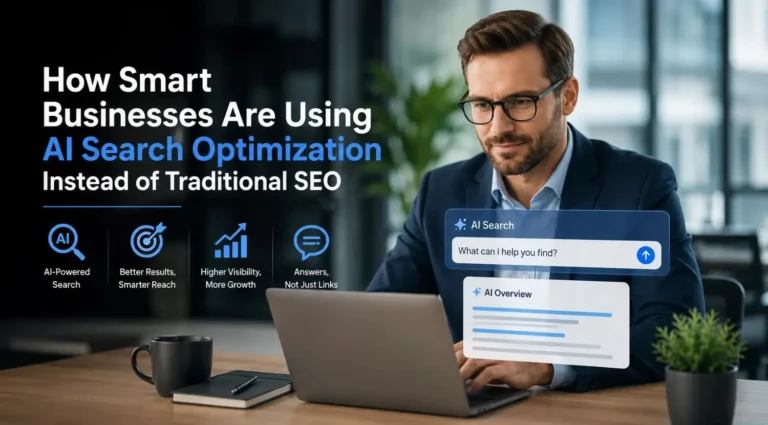
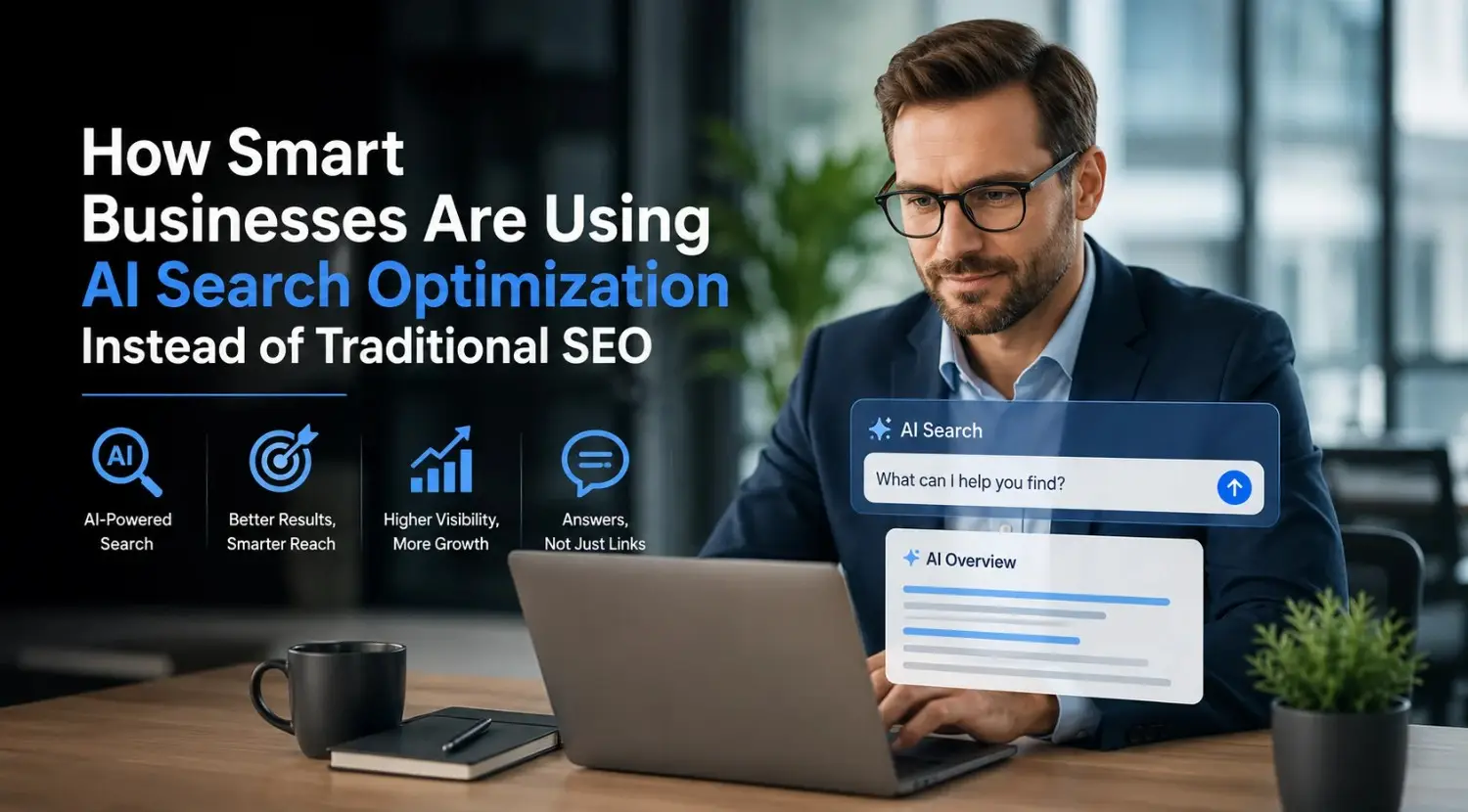
The smartest businesses in 2026 have stopped asking “how do we rank higher on Google?” They are asking a different question entirely: “how do we get recommended by ChatGPT, cited by Perplexity, and quoted in Google’s AI Overviews?”
This is not a subtle shift in tactics. It is a complete change in what the goal of search visibility even is. Traditional SEO optimised for a position in a list of ten blue links. AI search optimization known as GEO, AEO, or AI SEO optimises for something different: becoming the answer itself.
While many companies are still grinding away at 2020-era SEO and watching their traffic quietly erode, a smarter cohort has already pivoted. This article breaks down exactly what they are doing differently, the specific tactics that work, and how to move your own business from “ranked” to “recommended.”
First, the Vocabulary: GEO, AEO, and AI SEO
The new field comes with new acronyms, and it helps to be precise about them.
AEO (Answer Engine Optimization) focuses on getting your content selected as a direct answer by AI-powered search engines and voice assistants. AEO is about selection being the source the machine extracts its answer from. It prioritises clarity, intent satisfaction, and trust over traditional keyword placement.
GEO (Generative Engine Optimization) goes a step further. GEO ensures AI systems mention, cite, or recommend your brand when generating long-form answers. If AEO answers the question, GEO influences the decision. GEO operates on what some practitioners call the “persuasion layer” shaping how AI talks about your brand, not just whether it finds you.
AI SEO is the umbrella term sometimes also called LLM SEO or LLMO for optimizing a website so AI systems can access, understand, extract, and trust its content.
In practice, most businesses need all of it. The terms overlap heavily, and the core tactics align. The key distinction from traditional SEO is simple: traditional SEO optimises for ranking; AI search optimization optimises for being understood, extracted, trusted, and recommended.
Why Smart Businesses Made the Switch
The pivot is not driven by novelty-chasing. It is driven by cold numbers.
As of early 2026, ChatGPT has surpassed 900 million weekly active users. Google AI Overviews appear in a large and rising share of all searches. Gartner’s prediction that traditional search volume would fall 25% by 2026 is playing out in real time.
But here is the statistic that genuinely changed boardroom thinking: AI referral traffic has been reported to convert at around 14.2% roughly five times higher than Google organic search at 2.8%. The logic is intuitive. When someone arrives at your site after an AI assistant specifically recommended you, they arrive pre-qualified and pre-trusted. The AI has already done the convincing.
So the smart-business case is not just defensive (“we’re losing Google traffic”). It is offensive: AI search traffic is lower in volume but dramatically higher in quality. Capturing it is a genuine competitive advantage and right now, while many competitors are ignoring it, that advantage is unusually cheap to seize.
What Smart Businesses Actually Do Differently
Here is the practical playbook the leading cohort is running.
1. They Measure AI Visibility First
Before optimizing anything, smart businesses establish an AI visibility baseline. They check how and whether their brand currently appears across ChatGPT, Perplexity, Gemini, and Claude. You cannot improve what you do not measure, and most businesses have never actually looked at what AI assistants say about them. The first move is always to ask the AI engines directly: “What are the best providers of X?” and see if you appear at all.
2. They Write Answer-First Content
Traditional SEO often buried the answer deep in a long, keyword-padded article to maximise time-on-page. AI search optimization does the opposite. Smart businesses lead with the answer.
The tactic is concrete: for any question their content targets, they provide a clear, accurate, self-contained answer of roughly 50 to 60 words near the top of the relevant section. AI systems extract these concise, quotable passages. A 50-word direct answer that an AI can lift cleanly beats a 500-word meander it cannot parse.
3. They Structure Content for Machine Extraction
AI systems read content differently from human readers. Smart businesses structure for extractability:
- Question-based headings that mirror how people actually ask things
- Concise paragraphs rather than dense blocks
- Lists, tables, and clear definitions that AI can lift cleanly
- A logical, predictable information hierarchy
Voice search reinforces this natural-sounding language, long-tail conversational phrases, and question-and-answer formats all help AI engines interpret and trust the content.
4. They Implement Schema Markup Strategically
Structured data schema markup tells AI systems explicitly what content means rather than making them guess. Smart businesses prioritise the schema types that matter: FAQ schema, HowTo schema, Article schema, and for location-based businesses, local business schema with clear service areas. They focus on schema types Google and Bing actually support, rather than marking up everything indiscriminately.
5. They Build Entity Authority, Not Just Keyword Rankings
This is one of the deepest shifts. AI systems think in terms of entities people, brands, products, concepts and the relationships between them. Smart businesses work to make their brand a clearly defined entity that AI models recognise and associate with their topic. That means consistent brand information across the web, topic-based site structure, and comprehensive coverage of a subject area rather than scattered pages each chasing a single keyword.
6. They Optimize Off-Site, Where AI Actually Looks
Perhaps the biggest mindset change: smart businesses know AI search optimization happens largely off their own website.
AI engines draw heavily on third-party sources when deciding who to cite and recommend. Studies of LLM citations show certain sites appear disproportionately often and Reddit, in particular, has strong visibility in both AI search results and traditional organic search. Smart businesses therefore ensure their brand is genuinely present in the conversations their customers are already having: participating authentically on Reddit and Quora, earning mentions on respected industry sites, securing reviews and third-party validation, and getting listed in credible directories.
A brand mention without a link still counts. AI systems register the association. This is “link building” reimagined as presence building being talked about, accurately, in the places AI trusts.
7. They Manage Brand Sentiment
GEO’s “persuasion layer” means it is not enough to be mentioned smart businesses care how they are mentioned. They monitor the sentiment of what the web says about them, because AI assistants synthesise that sentiment into recommendations. Positive, consistent, credible third-party coverage is what moves an AI from listing you to actively recommending you.
8. They Find and Fill Content Gaps
Rather than creating content based on what they want to say, smart businesses analyse what the market is asking that is not being answered well. They expand Google’s “People Also Ask” trees, study the sub-questions AI engines generate, and produce genuinely better, more complete, more original content than what currently gets cited. Filling these vacuums first captures high-intent attention competitors are ignoring.
The Critical Nuance: It’s “In Addition To,” Not “Instead Of”
The title of this article says “instead of traditional SEO” and that captures the mindset shift accurately. But the smartest businesses understand an important caveat: traditional SEO is not dead, and abandoning it entirely would be a mistake.
Traditional search still refers a significant amount of traffic. Many of the sites AI engines cite most often also rank well in traditional organic search the two systems are connected, not opposed. The genuinely smart approach is to keep doing the SEO fundamentals that still work (technical health, quality content, legitimate authority) while augmenting them with AI search tactics: entity optimization, fan-out query coverage, schema, answer-first structuring, and off-site presence.
The shift is not “delete your SEO strategy.” It is “stop treating ranking as the finish line.” Ranking is now one input into a bigger goal: being the trusted source AI chooses. Smart businesses strike the balance rather than swinging blindly from one extreme to the other.
A Practical Roadmap for Your Business
For a business looking to make this shift, the sequence is straightforward:
Start by measuring ask ChatGPT, Gemini, Perplexity, and Claude what they say about your brand and your category today. Audit your top content and rewrite it answer-first, with concise 50-60 word answers near the top of each section. Add structured data for your most important pages. Restructure your site around topics and entities rather than isolated keywords. Build genuine off-site presence on Reddit, Quora, and respected industry platforms where your customers and the AI engines are both looking. Monitor how AI assistants describe you over time, and treat that as a core visibility metric alongside rankings and traffic. And throughout, keep your proven SEO fundamentals running augment, don’t abandon.
The Bottom Line
The businesses winning search visibility in 2026 are not the ones with the most keywords or the most backlinks. They are the ones AI engines trust enough to quote and confident enough to recommend.
AI search optimization GEO, AEO, AI SEO is how smart businesses are adapting. They lead with clear answers, structure content for machines, build entity authority, manage their off-site reputation, and measure visibility by AI citations rather than rankings alone. They have grasped the core truth of this era: visibility is no longer about being found, it is about being chosen.
Traditional SEO got you onto the list. AI search optimization makes you the answer. The businesses that understand the difference and act on it now, while the field is still uncrowded will own the next decade of digital visibility. The rest will keep optimizing for a list that fewer and fewer people are reading.