
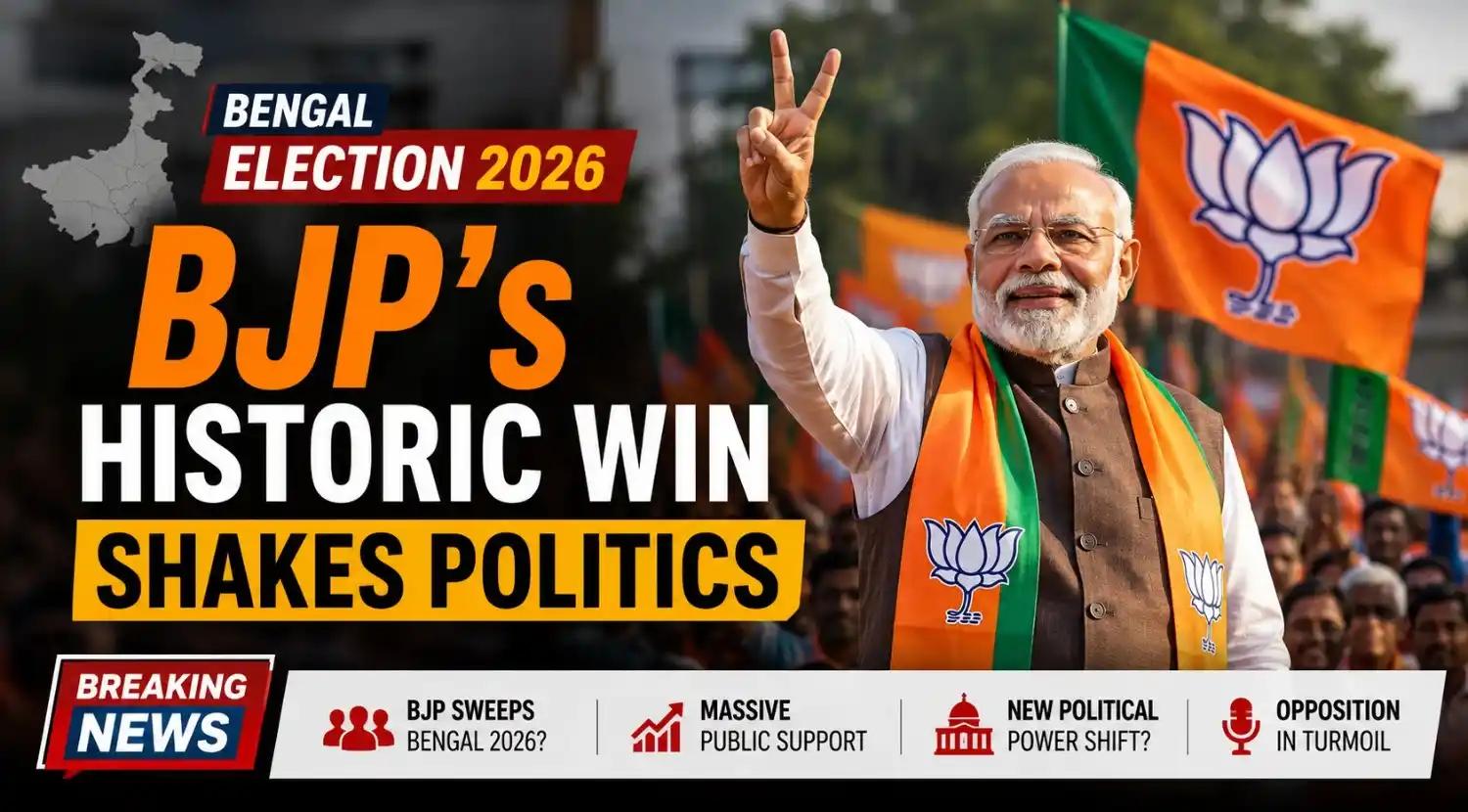
The political map of eastern India has been redrawn. The 2026 West Bengal Legislative Assembly election results, declared on 4 May 2026, have delivered one of the most consequential mandates in the state’s post-independence history. The Bharatiya Janata Party (BJP) has crossed the majority mark with stunning ease, dethroning the Trinamool Congress (TMC) after fifteen years of uninterrupted rule under Chief Minister Mamata Banerjee. But the verdict itself is only half the story. The other half — and the one currently dominating prime-time debates and front pages — is Banerjee’s defiant refusal to resign, her allegations that the mandate was “looted,” and the constitutional question now hanging over Kolkata’s Raj Bhavan.
The Numbers: A Saffron Sweep Across Bengal
For the first time since the Left Front’s defeat in 2011, West Bengal will be governed by a party other than the Trinamool Congress. The BJP won 206 of the state’s 294 assembly seats, sailing well past the 148-seat majority mark, while the TMC was reduced to roughly 80 seats. The election covered 293 of the 294 constituencies in two phases on 23 and 29 April 2026, with one remaining constituency scheduled to vote on 21 May. Voter turnout touched a historic 92.93 per cent — the highest ever recorded in a West Bengal assembly election.
The most symbolically devastating result for the TMC came from Bhabanipur, Mamata Banerjee’s own stronghold. She lost her seat to BJP heavyweight Suvendu Adhikari, the man who was once her closest political lieutenant before defecting to the BJP in 2020. This is the second time Adhikari has personally defeated her — in 2021, she lost to him in Nandigram before re-entering the assembly through a Bhabanipur by-election. This time, he followed her to her home turf and won again, a moment many commentators are calling the political bookend to Banerjee’s 15-year chief ministership.
How the BJP Engineered the Bengal Breakthrough
The saffron party’s victory did not emerge in isolation. Several long-running political currents converged to produce this result.
Anti-incumbency at scale. Fifteen years is a long time in any democracy, and surveys throughout 2025 had picked up cumulative fatigue with the TMC government — particularly around governance complaints, the school recruitment scam, and ongoing central-agency investigations into senior party functionaries. The BJP framed these as evidence of systemic decay rather than isolated incidents.
The Suvendu Adhikari factor. Adhikari’s slogan — “Ami ekhankar chhele” (I am the son of this soil) — was a direct rebuttal to the TMC’s long-standing strategy of branding the BJP as an “outsider” force in Bengali politics. It worked. Adhikari brought intimate knowledge of TMC’s organisational structure into the BJP, and the party deployed it surgically across East Midnapore, Hooghly, and the Jangalmahal belt.
Identity, citizenship, and the Matua vote. The Citizenship Amendment Act, the Special Intensive Revision (SIR) of voter rolls, and questions around cross-border migration became defining campaign themes. The BJP’s promise to fast-track citizenship under the CAA resonated strongly in Matua-dominated belts and refugee-heavy constituencies, while the TMC’s counter-framing — that these issues were being weaponised to polarise the electorate — failed to hold ground in key seats.
Women’s safety after R. G. Kar. The 2024 R. G. Kar Medical College and Hospital case remained an open wound throughout the campaign, and BJP leaders kept it central to their critique of law and order under the TMC government. This particularly affected the urban women’s vote, which had previously been a TMC stronghold.
Urban turnout transformation. Kolkata and other urban centres, historically marked by lower turnout, saw sharp increases. The Election Commission’s setting up of new booths inside high-rises and housing complexes — places that had in earlier years been allegedly locked down by ruling-party-linked mobs during polling — appears to have unlocked a significant chunk of previously suppressed urban voters who broke heavily against the incumbent.
Mamata Banerjee’s Refusal to Resign: What She Said and Why It Matters
A day after the results, on Tuesday, 5 May 2026, Mamata Banerjee held a press conference in Kolkata that has become the defining political moment of the post-result period. She refused to step down as chief minister and rejected the verdict outright, arguing that the votes had been “looted by force” and that the entire voting process was rigged. She accused the Election Commission of bias, calling its conduct a “dark chapter” in India’s democratic history, and insisted that the Trinamool Congress had not actually lost the election — that the mandate had been stolen rather than freely given.
This is a sharp departure from her own past behaviour. After the BJP’s strong 2019 Lok Sabha showing in the state, she actually offered to resign as chief minister; her party rejected the offer. After the 2021 assembly result, when the TMC won decisively, she resigned ceremonially as required and was sworn in for a third term. The 2026 posture — categorical refusal to vacate office in the face of a clear adverse mandate — is without precedent in her career.
The Constitutional Question: Does It Even Matter?
The BJP has responded to her stance with a sharply legalistic argument. Party spokespersons have pointed out that whether Banerjee resigns or not, the term of the present assembly ends on 7 May 2026 — within forty-eight hours of her press conference. After that date, no member of the outgoing house remains an MLA, and the question of resignation becomes moot. The governor will simply invite the leader of the BJP legislature party to form the new government.
In Indian constitutional convention, an incumbent chief minister whose party has lost the assembly majority is expected to tender resignation to the governor, who then asks the largest party or pre-poll alliance to form the next government. The outgoing CM typically continues in a caretaker capacity until the new ministry is sworn in. Banerjee’s refusal does not, in practice, prevent the new government from being formed — but it does create a striking political tableau that the BJP is using to underscore what it calls her departure from democratic norms.
Who Will Be the Next Chief Minister of West Bengal?
The succession question is the most active political conversation in Delhi this week. Prime Minister Narendra Modi was expected to hold meetings with Home Minister Amit Shah and BJP national president Nitin Nabin to finalise the chief minister and key cabinet positions. Bengal BJP president Samik Bhattacharya and Suvendu Adhikari have both been asked to remain in New Delhi.
Adhikari is the obvious frontrunner. He led the campaign, anchored the bhoomiputra narrative, and personally defeated Banerjee in Bhabanipur. But the party is also weighing factors of caste balance, RSS representation (more than 100 RSS-rooted candidates won), and the inclusion of younger faces. Names being discussed for cabinet positions include Swapan Dasgupta, Agnimitra Paul, Nishith Pramanik, Roopa Ganguly, and Rudranil Ghosh.
The National Implications
This result extends a continuous BJP-governed corridor across eastern India — Bihar, Odisha, and now West Bengal — fundamentally reshaping the political and economic geography of the region. For the opposition INDIA bloc, the loss of West Bengal removes one of its most prominent state governments and a central figure who had been positioning herself as a national alternative voice. For the BJP, it closes one of the last remaining gaps in its national footprint and gives the party direct administrative control over a state it has spent more than a decade trying to crack.
Closing Thoughts
The 2026 West Bengal verdict is being read on multiple registers — as an anti-incumbency wave, as a triumph of organisational engineering by the BJP, and as the moment a fifteen-year political era ended. Mamata Banerjee’s refusal to resign has injected genuine political controversy into what would otherwise have been a clean transition, but constitutional reality is likely to overtake political defiance well within the week. The bigger questions — who governs Bengal next, how the TMC reconstructs itself in opposition, and what this realignment means for the 2029 general election — will define Indian politics for the rest of the decade.