For over two decades, one machine decided who got noticed on the internet. You typed a query into Google, scanned ten blue links, and clicked. Businesses lived or died by where they landed in that list. An entire industry search engine optimisation was built around climbing it.
In 2026, that machine is being rebuilt from the inside out. AI is no longer something layered on top of Google search. It has become the search. AI Overviews answer questions before the links appear. Google’s AI Mode replaces the results page entirely. ChatGPT, Perplexity, Gemini, and Claude intercept queries that never reach Google at all. The result is a slow-motion collapse of the traditional SEO model and a fundamental reshaping of where web traffic flows.
This is not a forecast. It is happening now, measurably, and the businesses that understand the mechanics of the shift are the ones that will survive it.
The Old Deal Is Breaking
To understand what is dying, you have to understand the deal that built the modern web. Google crawled your content for free. In exchange, when someone searched for what you offered, Google sent them to your site. You got traffic; Google got a great search product. Everyone won.
Traditional SEO was the craft of optimising for that deal keywords, backlinks, page speed, meta tags, content freshness. Get those right, rank on page one, and the clicks followed.
That exchange is now being quietly rewritten. Google increasingly uses your content to generate its own answer, displayed at the top of the page, and the user never needs to click through. Your content still gets crawled. It still gets used. But the traffic that used to come back to you in return is increasingly kept by Google itself.
The deal hasn’t been renegotiated. It has just stopped paying out.
The Mechanics: Three Ways AI Search Drains Your Traffic
AI search doesn’t reduce traffic through a single mechanism. It drains it through three at once.
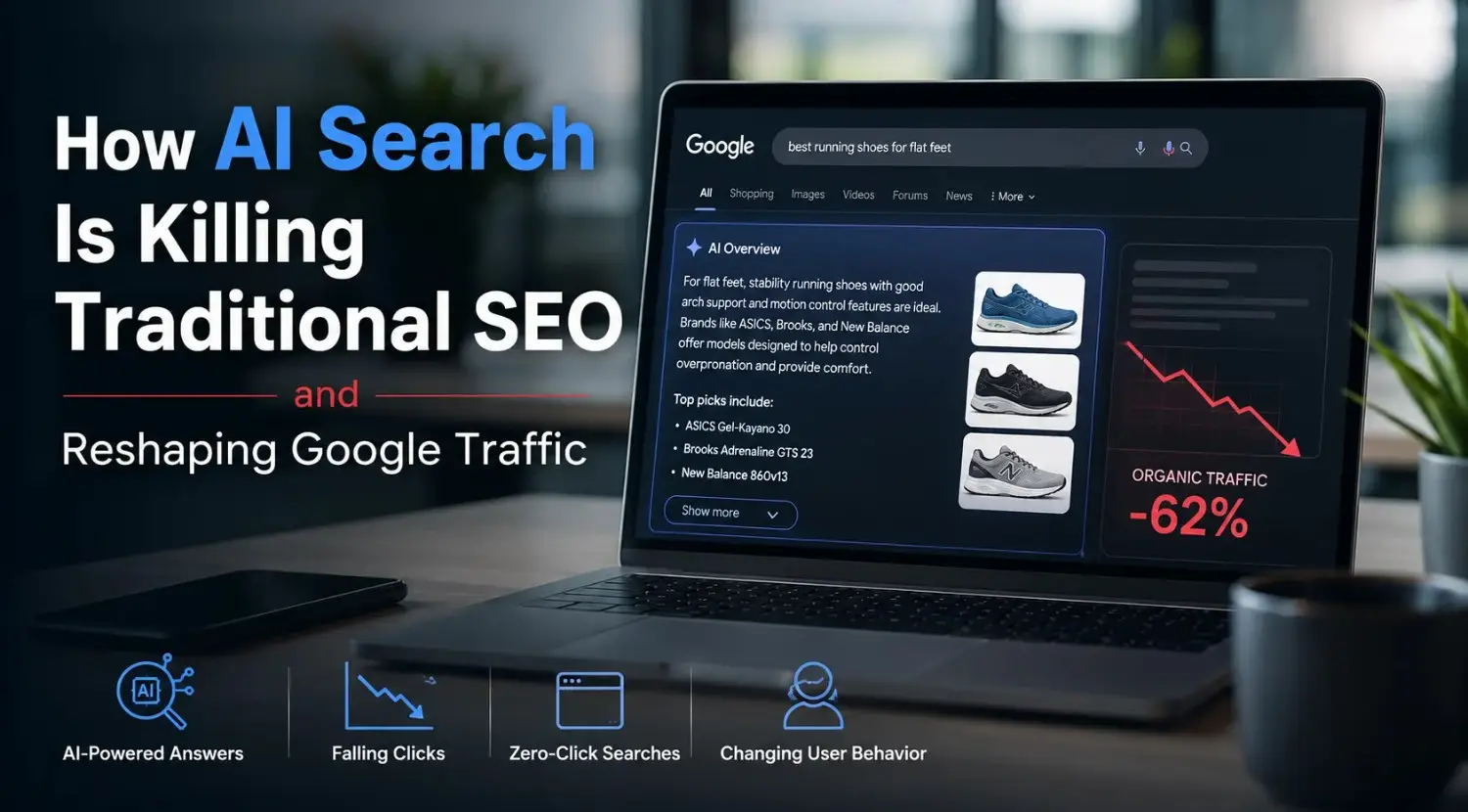
Mechanism one: the answer moves above the links. Google AI Overviews now appear in roughly 48% of all searches as of early 2026, up from around 34% just a few months earlier and on informational and how-to queries, coverage exceeds 70%. When the answer sits at the top of the page, written from your content, the user’s need is met before they scroll. The click that used to be yours simply never happens. On queries where an AI Overview appears, the click-through rate for the number one organic result has fallen by as much as 61%.
Mechanism two: the results page itself disappears. Google’s AI Mode is not a feature added to search results it is a replacement for them. It has reportedly reached 75 million daily active users, and roughly 93% of those sessions end without a single click to any website. There are no ten blue links to optimise for. There is a conversation, and a handful of citations.
Mechanism three: the query never reaches Google. ChatGPT, Gemini, Perplexity, Claude, and Copilot now handle billions of queries that would once have started on Google. A user who asks ChatGPT how to structure a contract, or asks Perplexity to compare two products, may complete their entire research journey without ever opening a search engine or visiting a single website.
The combined effect is stark: roughly 58% of all Google searches now end without any click at all. Gartner has forecast that traffic from traditional search engines will fall 25% by 2026, with steeper declines projected in some verticals through 2028.
The Symptom Everyone Is Reporting
There is one specific pattern that thousands of marketers and site owners are describing in 2026, and it is worth naming clearly because it is so disorienting: rankings look fine, impressions are flat or even up but clicks and revenue keep falling.
This is the signature of AI search disruption. In the old model, ranking number one and getting traffic were the same thing. AI search has severed that link. You can hold your position, appear in just as many searches, and still watch your traffic erode because the searches are being answered without you.
If your analytics show this exact divergence, you are not imagining it, and you are not doing anything wrong. The ground has moved.
The Casualties Are Real and Named
This is not abstract. The damage has names attached.
The Mail Online reported its organic click-through rate fell from 13% to 5% on desktop, and from 20% to 7% on mobile, when an AI Overview appeared above its results. Business Insider’s organic search traffic dropped 55% between April 2022 and April 2025, contributing to the company cutting 21% of its staff. HuffPost lost roughly half of its search referral traffic over the same period. The travel blog The Planet D reported losing half its traffic in the months after AI Overviews launched. The New York Times saw search fall from 44% of its traffic in 2022 to 37% in 2025.
Industry data shows 73% of B2B websites experienced significant organic traffic losses between 2024 and 2025. These are not isolated bad-luck stories. They are the leading edge of a structural shift.
Why “Traditional SEO” Specifically Is Dying
It is worth being precise about what is dying. Search itself is not disappearing people search more than ever. What is dying is the traditional SEO model: the specific assumption that ranking in the ten blue links reliably converts into traffic.
Two findings show why the old playbook no longer works.
First, citation decoupling. According to Ahrefs data, only 38% of pages cited in AI Overviews also rank in the top 10 organic results down from 76% just seven months earlier. AI search increasingly cites pages that don’t rank well, and ignores pages that do. The thing traditional SEO optimised for top-10 ranking is no longer the thing that earns AI visibility.
Second, what AI search actually rewards is different. Pages above 20,000 characters average around 10 citations each in AI Overviews; pages under 500 characters average 2.4. AI engines favour comprehensive depth and genuine expertise over the thin, keyword-tuned pages that traditional SEO often produced at scale. The content that gamed the old system is precisely the content AI search discards.
A team still running its 2023 SEO strategy in 2026 is optimising for a machine that no longer exists.
Query Fan-Out: The New Algorithm Underneath It All
One technical change deserves special attention because it reshapes strategy completely. Google’s AI Mode uses a technique called “query fan-out.” When a user submits a query, the system silently breaks it into many related sub-queries, runs an internal search for each, and assembles the answer from across all of them.
The strategic implication is profound. Citation priority goes to pages that appear across multiple sub-queries not pages that rank number one for the single head term. A page with moderate relevance across ten related sub-topics will beat a page that dominates one keyword and is invisible for the rest.
This kills single-keyword SEO and replaces it with topic-cluster authority. Comprehensive coverage of a subject, strong internal linking, and genuine topical depth now matter more than any individual keyword on any individual page.
What Actually Works Now
The shift is brutal, but it is not hopeless. The leading-edge data points to a clear set of adaptations.
Lead with the answer. AI engines extract discrete, quotable claims. Bury your answer in paragraph six and it won’t be cited. State it clearly and directly near the top of each section.
Build depth and demonstrate experience. Google’s E-E-A-T framework Experience, Expertise, Authoritativeness, Trustworthiness is now the dividing line. Generic information gets absorbed silently into AI summaries. Specific, first-hand, experience-driven content gets cited by name. Document how you actually solve problems instead of merely explaining concepts.
Optimise for citation, not just ranking. This is the rise of Generative Engine Optimisation (GEO) and Answer Engine Optimisation (AEO) structuring content with question-based headings, schema markup, and clear direct answers so AI engines can extract and attribute it. Track whether you appear in AI Overviews and chatbot answers, not just where you rank.
Build topic clusters, not keyword pages. Given query fan-out, comprehensive coverage of a subject area beats isolated pages targeting single terms.
Diversify beyond search. Email, social, video, podcasts, community, and direct traffic become essential as search referrals shrink. Strong brand recognition matters enormously when users search for you by name, AI assistants are far more likely to surface you.
Move down the funnel. AI Overviews fully answer informational queries but struggle with comparisons, pricing, case studies, and original research. Content that requires genuine evaluation or proprietary data is more defensible.
How This Reshapes Google Itself
The final piece of the story is what all this means for Google. The company faces a genuine dilemma. Its dominance was built on being the best place to find links to the web. AI Overviews and AI Mode make Google a better answer engine but in doing so, they weaken the open web that supplies Google’s answers in the first place.
Some analysts warn of a potential “Zero Result SERP” a future where Google removes organic links entirely in favour of AI-generated answers. With 93% of AI Mode sessions already ending without a click, that future is arguably already here in practice for many queries.
The longer-term risk is circular: if AI search starves the websites that produce original content, the supply of fresh, high-quality information that AI search depends on begins to dry up. This tension between Google as answer engine and Google as the web’s traffic distributor is the defining unresolved question of search in 2026.
The Bottom Line
AI search is not a passing algorithm update. It is a structural redesign of how information is found, answered, and monetised online. Traditional SEO the discipline of climbing ten blue links for clicks is being dismantled in real time, and the traffic charts of publishers from Business Insider to small independent blogs prove it.
But the businesses that face this clearly still have a path. The winners of this era will not be those clinging to 2023 tactics. They will be those who build genuine depth and expertise, optimise to be cited rather than merely ranked, develop brand recognition that survives the click decline, and diversify their traffic so no single algorithm can decide their fate.
Search is being reshaped. Google is being reshaped. The open web is being reshaped. The only real question for any business that depends on online visibility is whether it reshapes itself fast enough to keep up.