
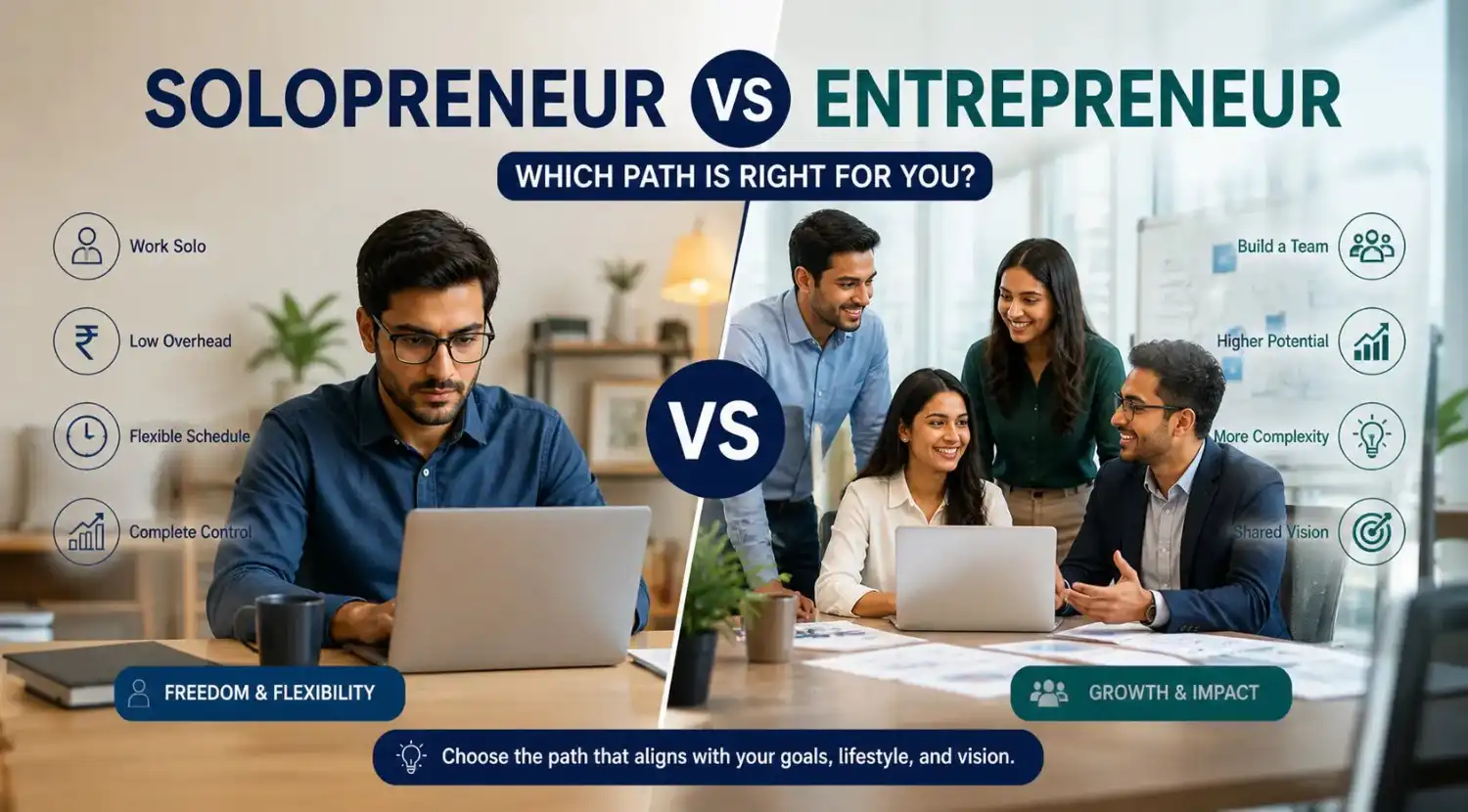
Two people start businesses on the same day. One works from a laptop at home, handles every client herself, and builds a steady six-figure income over three years without hiring a single employee. The other starts with a small team, raises funding, builds systems and processes, and eventually steps back from daily operations to focus on strategy and growth.
Both are successful. Both took real risks. But they built fundamentally different things — and the path each chose was shaped by fundamentally different values, goals, and definitions of what success looks like.
The question of whether to pursue a solopreneur path or an entrepreneurial one is not a question about how ambitious you are. It is a question about what kind of life you want to build, what kind of work you find meaningful, and what kind of risk you are genuinely equipped to carry. Getting the answer right at the outset saves years of misdirection. Getting it wrong can mean building something that technically succeeds but makes you miserable.
This article will give you a clear, honest framework to make that decision for yourself.
What Is a Solopreneur?
A solopreneur is someone who builds, operates, and runs a business entirely on their own. They are simultaneously the founder, the employee, the marketer, the salesperson, the customer service department, and the accountant. They may occasionally hire freelancers for specific tasks — a logo designer, a tax consultant at year-end — but the core of the business depends entirely on them, and they have no intention of building a permanent team.
Crucially, a solopreneur is not simply someone who has not hired people yet. The distinction is one of intention. A solopreneur deliberately chooses to keep the business personal and self-contained. The business is an expression of their individual skills, knowledge, or creative output. Growth, if it happens, happens within boundaries the solopreneur sets — not because they are afraid to grow, but because they are not trying to build an organization. They are trying to build a life.
According to Shopify data, over 40 percent of new businesses started in 2024 began as solo operations. The categories most naturally suited to solopreneurship include consulting, coaching, content creation, freelance writing and design, photography, software development, online course creation, and independent e-commerce. These are fields where one skilled person can deliver genuine value to clients or customers without needing a team behind them.
The solopreneur model has become significantly more viable in recent years because of technology. As one business analysis noted, solopreneurs rely on tools and automation rather than people to grow — AI assistants, no-code platforms, automated invoicing, social media scheduling, and outsourced accounting have made it possible for a single person to handle what used to require a full department.
What Is an Entrepreneur?
An entrepreneur is someone who builds a business with the explicit intent of growing it beyond themselves. They start with a vision that requires other people to execute — not because they lack skills, but because the scale they are aiming for cannot be achieved by a single person working alone.
Entrepreneurs build systems, hire teams, delegate responsibilities, and work toward creating an organization that can eventually run independently of their day-to-day involvement. Their goal is often not just income but an asset — something that has value in and of itself, that could be sold, scaled, or passed on.
The entrepreneurial path typically requires significantly more capital. Hiring employees means payroll. Scaling operations means infrastructure. Reaching larger markets means sales and marketing investment. The financial risk is commensurately higher — but so is the potential upside. A solopreneur who builds a great consulting practice might earn two to three times their previous salary. An entrepreneur who builds a successful company can create wealth of a different order entirely.
Entrepreneurs also spend their time differently. In the early stages, a founder does everything — but the goal is always to move from doing to managing, and eventually from managing to leading. An entrepreneur who is still personally handling client delivery five years into building their company has either failed to grow or has accidentally become a solopreneur without realizing it.
The Six Key Differences
Understanding the distinctions clearly is more useful than a simple definition. Here is how the two paths differ across the dimensions that matter most.
Structure and team. A solopreneur is both the owner and the workforce. An entrepreneur builds a team and creates systems that allow others to do the work. This is not a difference in capability — it is a difference in design intention.
Growth goals. Solopreneurs typically seek sustainable, manageable businesses that support their desired lifestyle. Entrepreneurs aim for scale, market share, multiple revenue streams, and often an eventual exit — acquisition, IPO, or sale.
Financial risk and capital. Solopreneurs almost always bootstrap, using personal savings and reinvesting profits. Their financial risk is lower because their overhead is minimal. Entrepreneurs frequently need external capital — from investors, lenders, or accelerators — and carry the weight of payroll and operational costs from early on.
Decision-making speed. Solopreneurs make decisions quickly because there is no one else to consult. Entrepreneurs operate within a more complex decision-making structure as their team grows — which creates accountability but also slows certain kinds of responsiveness.
Personal brand vs company brand. For a solopreneur, the business and the personal brand are often inseparable. Clients hire the person. For an entrepreneur, the goal is typically to build brand equity in the company itself — something that exists independently of any individual, including the founder.
Exit and legacy. Most solopreneurs do not plan to sell their business. Their work is the point. Entrepreneurs often build with an exit in mind — their business is an asset to be maximized and eventually liquidated or transferred.
The Honest Advantages of Each Path
Neither path is objectively superior. Each has genuine advantages that the other lacks — and the right choice depends entirely on what you actually want.
Advantages of the solopreneur path:
Full autonomy over every decision — no board, no investors, no team politics. You work on what you choose, with whom you choose, at the pace you choose. Your overhead is low, which means profitability comes earlier and the financial pressure is lower. You retain all profits. You can change direction quickly because there is no organizational inertia to overcome. And your work is genuinely yours — the quality, the reputation, and the outcomes are directly connected to your own effort and skill.
Advantages of the entrepreneurial path:
Scale. A business with a team can serve more customers, generate more revenue, and create more impact than any single person can manage alone. Entrepreneurs can build something that outlasts their direct involvement. They can diversify across multiple products, markets, or revenue streams in ways that a solopreneur’s time constraints make impossible. And they can build genuine organizational value — an asset whose worth extends far beyond any single year’s income.
The Honest Disadvantages of Each Path
The solopreneur path has real limits. You are the ceiling. Your income is bounded by the hours you can work and the rates you can charge. If you get sick, take a holiday, or simply need to step back, the business pauses with you. You carry all the risk alone — there is no team to share the burden, no partner to think through problems with, no organizational resilience when things go wrong. Loneliness and isolation are genuine challenges that many solopreneurs underestimate.
The entrepreneurial path demands a great deal. The capital requirements are significant, the personal financial risk is higher, and the early years of building a team require skills — hiring, management, culture-building, conflict resolution — that have nothing to do with whatever the business actually does. Many founders discover that what they loved about their work disappears as the company grows and their role shifts from doing to managing. Building a team is its own full-time job, and not everyone is suited to it or interested in it.
How the Lines Are Blurring in 2025
One of the most interesting developments in the current business environment is how fluid the boundary between solopreneur and entrepreneur has become.
Technology has expanded what a single person can achieve. An individual with AI tools, no-code software platforms, global freelance networks, and automated systems can today build businesses that would have required teams of fifteen people a decade ago. This has made solopreneurship a genuinely strategic choice rather than a fallback for people who cannot build a team.
At the same time, many entrepreneurs now start solo and transition intentionally into team-building once they have validated their market, generated initial revenue, and identified the specific leverage points where additional people create compounding returns rather than just additional complexity.
The path is not always a binary choice made once and held forever. Many successful business builders start as solopreneurs, develop a clear model and market, and then evolve into entrepreneurs when the opportunity and their own readiness align.
A Framework for Deciding Which Path Is Right for You
Before making this decision, answer these questions honestly — not aspirationally, but based on what you actually know about yourself.
What does your ideal workday look like? If the answer involves deep focus on a craft, direct client relationships, and autonomy over your schedule — solopreneurship is likely a better fit. If it involves building something, leading people, solving organizational problems, and working toward a long-term institutional goal — entrepreneurship is more aligned.
What is your relationship with risk? Solopreneurship carries personal operational risk — if you cannot work, the business stops. Entrepreneurship carries capital risk, employment risk for your team, and reputational risk at greater scale. Neither is risk-free, but they are different kinds of risk.
What does success look like to you in ten years? A solopreneur’s ten-year success might look like a well-known personal brand, a stable client base, and complete control over her time. An entrepreneur’s ten-year success might look like a company with twenty employees, multiple product lines, and a meaningful market position. Neither is more ambitious — they are simply different visions.
How do you feel about management? This question alone eliminates a great deal of confusion. Many people who describe themselves as wanting to build a business discover that they hate managing people. If leadership and organizational development genuinely energize you, entrepreneurship makes sense. If they drain you and distract you from the work you love, solopreneurship is the more honest path.
The India Context in 2025
For Indian professionals and entrepreneurs in particular, this decision carries specific relevance. India’s startup ecosystem has never been more supportive of both paths simultaneously.
For solopreneurs, the combination of global freelance platforms, UPI-enabled payment infrastructure, social media distribution, and growing domestic demand for specialized expertise has made building a sustainable solo business more accessible than at any prior point. Indian consultants, coaches, designers, and content creators are building significant incomes serving both domestic and international clients.
For entrepreneurs, India’s scale — a billion-plus consumer market, a young workforce, and deep government support through programs like Startup India and various PLI schemes — creates opportunities for company-building that few other markets can match. The right combination of market insight, execution capability, and access to capital can still build something extraordinary.
Both paths are available. The question is which one is right for you specifically — not which one sounds more impressive at a dinner party.
Conclusion
The solopreneur versus entrepreneur debate is ultimately not about scale or ambition. It is about self-knowledge. The most successful people on both paths are those who chose deliberately — who understood what they actually wanted, what they were genuinely suited for, and what kind of business would make their daily work feel meaningful rather than draining.
A solopreneur who builds a thriving, personally fulfilling business of one has succeeded. An entrepreneur who builds a company that creates employment, serves customers at scale, and generates lasting institutional value has also succeeded. The measure is not the size of the organization — it is whether the path you chose was the right one for who you actually are.
Start there. The strategy follows.