A decade ago, the answer to this question was simple. You went to college, earned a degree, and used it to land a job. Online courses were seen as side hobbies—useful for learning a new skill, but never a real substitute for a “proper” education. Fast forward to 2025, and the conversation looks completely different. Major tech companies have dropped degree requirements. Online certifications from platforms like Coursera, Udemy, Google, and Microsoft are now respected credentials. Self-taught developers, designers, and marketers are landing six-figure jobs without ever stepping into a college classroom.
So which path is actually more valuable today—a traditional degree or an online certification? The honest answer is that both can be valuable, but for very different reasons, in very different fields, and for very different people. This article breaks down what each path actually offers, where each one wins, and how to make the right choice based on your goals.
How the Education Landscape Has Changed
To understand the debate, it helps to look at how dramatically the education and job market have shifted in the last few years.
Companies are increasingly hiring for skills, not credentials. Google, Apple, IBM, Tesla, Accenture, and many startups have publicly removed bachelor’s degree requirements for many roles. They now prioritize portfolios, real-world experience, and demonstrated abilities. The rise of generative AI, remote work, and global hiring has accelerated this trend.
At the same time, the cost of traditional education has skyrocketed. A four-year engineering or management degree can cost ₹15-40 lakh in India and crore-plus amounts abroad. Many graduates take years to recover financially, especially if they end up in roles that don’t require their specific degree.
Online learning, meanwhile, has matured significantly. Platforms now offer university-backed degrees, professional certificates from major companies, micro-credentials, and even employment guarantees. The quality of online courses has improved, and employers have become more comfortable evaluating non-traditional credentials.
In short, the playing field is more level than ever. But that doesn’t mean the choice is simple.
What a Traditional Degree Actually Offers
A college or university degree is much more than a piece of paper, even if its perceived value has decreased in some industries.
Structured, Comprehensive Learning
A degree program forces you to learn fundamentals systematically. In engineering, that means math, physics, programming, electronics, and design across multiple semesters. In commerce, it covers accounting, economics, business law, taxation, and finance. This breadth gives you a foundation that’s hard to replicate through scattered online courses, even if you’re highly motivated.
Credibility and Filtering
For better or worse, a degree from a reputed institution still acts as a filter. Many companies—especially in finance, consulting, government, healthcare, law, and engineering services—either require degrees or strongly prefer candidates with them. A degree from IIT, IIM, NLU, AIIMS, or top-tier global universities still opens doors that online certifications often can’t.
Networking and Peer Learning
Some of the most valuable parts of college aren’t in the syllabus. The friends you make, the professors you connect with, the alumni network you join, the projects you build with classmates—these relationships often shape your career more than any course content. Many successful businesses, partnerships, and career opportunities trace back to college networks.
Campus Placements and Internships
Most reputed colleges run structured placement programs that connect students directly with employers. For first-time job seekers without prior work experience, this institutional support is hard to replicate independently.
Required for Specific Careers
Some careers simply cannot be pursued without a recognized degree. Doctors, lawyers, chartered accountants, engineers in regulated fields, teachers in formal education, scientists, civil servants, and many government positions require specific qualifications that online certifications cannot replace.
The Downsides
That said, a traditional degree has real drawbacks. The cost is substantial, especially for private institutions or international universities. The opportunity cost of 3-5 years is significant. Curriculum often lags behind industry needs, especially in fast-moving fields like AI, design, and digital marketing. Many graduates emerge with theoretical knowledge but limited practical skills. And in oversaturated fields, a degree alone is no longer enough to stand out.
What Online Certifications Actually Offer
Online certifications have come a long way from the early days of MOOCs. In 2025, they’re a legitimate path for skill-building and career growth.
Speed and Flexibility
Online certifications can be completed in weeks or months, not years. You can study at your own pace, around your job, family, or other commitments. This makes them ideal for working professionals upskilling, career switchers, and students supplementing their degrees.
Cost-Effective
Most online courses cost a fraction of a traditional degree. Even premium professional certificates from Google, Meta, IBM, AWS, and similar providers are typically priced between ₹2,000 and ₹50,000—a tiny fraction of college fees. Many courses are even free if you don’t need the certificate.
Industry-Relevant Content
The biggest advantage of online courses is that they’re updated frequently and built around current industry needs. A digital marketing certificate today actually teaches you about the platforms and tools you’ll use at work—not theoretical concepts from a textbook written a decade ago. Cloud computing, AI/ML, data analytics, cybersecurity, UX design, and product management certifications are particularly strong examples.
Demonstrable Skills
Many certifications come with hands-on projects, capstones, or real-world assignments that you can showcase in your portfolio. For employers evaluating candidates, a portfolio of working projects is often more convincing than a certificate of completion.
Specialization on Demand
If you’re already working and want to pivot or specialize, online certifications let you target exactly the skills you need. You can become a Salesforce-certified developer, Google-certified data analyst, AWS-certified cloud architect, or HubSpot-certified marketer—each opening up specific career paths.
The Downsides
Online certifications also have real limitations. Many of them are surface-level and don’t build deep expertise. Quality varies widely—a certificate from Stanford on Coursera is very different from a random Udemy course with no quality control. Without a degree, you may face barriers in industries that still gatekeep on credentials. Self-paced learning requires discipline that not everyone has, and dropout rates are notoriously high. And while companies increasingly accept certifications, recruiters’ first filters in many large organizations still default to degree-based screening.
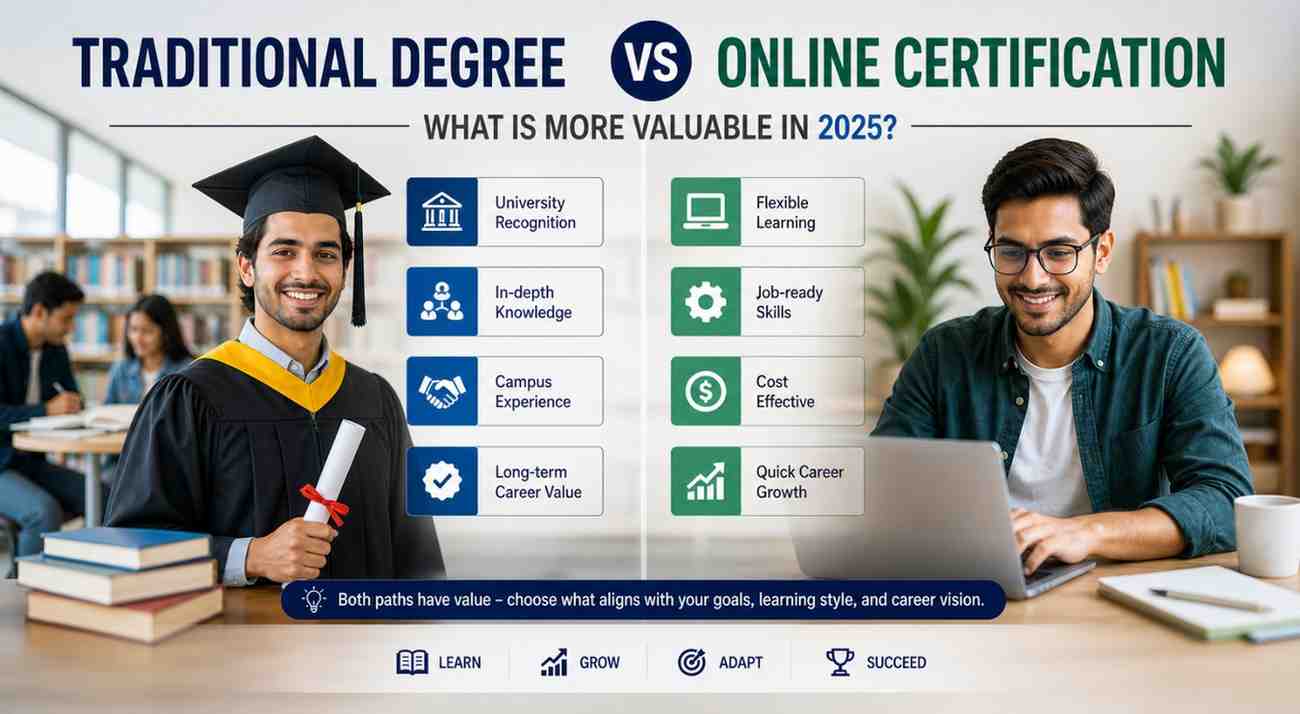
Direct Comparison: Where Each One Wins
Let’s compare both paths across the factors that matter most.
Cost: Online certifications win clearly. They’re often 10-100x cheaper than degrees.
Time investment: Online certifications win. Weeks vs years.
Depth of learning: Degrees usually win, especially in scientific, technical, and theoretical fields. Online courses excel at narrow, applied skills.
Industry relevance: Online certifications win, especially in fast-moving fields. Degree curricula often update too slowly.
Networking: Degrees win significantly. Online courses rarely create strong peer networks.
Job placement support: Degrees from good institutions win. Most online platforms offer limited career services.
Recognition by employers: Mixed. For tech, design, and marketing roles, certifications + portfolio often work great. For finance, law, medicine, government, and academia, degrees still dominate.
Career flexibility: Online certifications win for switching specializations quickly. Degrees give a stronger foundation for long-term career building.
International mobility: Degrees win. Most countries’ work visas and immigration systems still prioritize formal education.
Personal development: Degrees offer broader life experience—social, cultural, emotional growth—that online courses cannot replicate.
Which One Suits Which Career?
The “better” choice depends heavily on what you want to do.
Where Degrees Are Still Essential
Medicine, law, chartered accountancy, civil engineering, government services (UPSC, state services), teaching at schools and colleges, research and academia, defense services, and many international careers all require specific degrees. There’s no shortcut here—if your dream career falls in this list, prioritize the degree.
Where Certifications Often Beat Degrees
Software development, web and mobile development, UI/UX design, digital marketing, data analytics, cloud computing, cybersecurity, product management, content writing, video editing, SEO, social media management, graphic design, and many startup roles are hugely portfolio-driven. In these fields, demonstrated skills often outweigh formal credentials. A self-taught developer with a strong GitHub profile or a designer with an impressive Behance portfolio can easily outshine someone with a generic degree.
Where Both Together Are Most Powerful
In most professional careers, combining a relevant degree with targeted certifications creates the strongest profile. An engineering graduate with AWS and Kubernetes certifications is more valuable than either alone. An MBA with digital marketing and data analytics certifications has a meaningful edge over a generic MBA. A commerce graduate with financial modeling, advanced Excel, and CFA Level 1 is more hireable than just a B.Com graduate.
The smartest move is often “degree + certifications” rather than “degree vs certifications.”
What Employers Actually Look For in 2025
Beyond the degree-vs-certification debate, here’s what hiring managers consistently say they value in 2025.
Practical, demonstrated skills—not just credentials. Can you actually do the job?
A strong portfolio of real work. Projects, case studies, GitHub contributions, articles, designs, marketing campaigns—evidence of your abilities.
Communication and problem-solving skills. The ability to work in teams, explain ideas clearly, and adapt to new challenges is often valued more than technical depth alone.
Continuous learning mindset. Employers want people who keep upgrading their skills, regardless of how they originally learned.
Relevant experience, including internships, freelance work, side projects, and open-source contributions.
Cultural fit and attitude. Increasingly, employers say they hire for attitude and train for skills.
Notice that “degree” or “certification” doesn’t appear on this list directly. Both are seen as proxies for these underlying qualities. The credential matters less than the substance behind it.
Practical Advice Based on Your Situation
Here’s how to think about the choice based on where you are in life.
If You’re Just Finishing School
For most students, a traditional undergraduate degree is still the safer, broader-foundation path—especially if you’re undecided about your career, want to keep options open, or are aiming for fields that require formal qualifications. Use your college years to also build skills through online certifications, internships, and projects. Don’t rely on the degree alone.
If You’re Already in College
Don’t wait for graduation to start building real skills. Take certifications in areas that interest you—coding, design, marketing, data analytics, finance—while you’re still in college. Build a portfolio. Do internships. By graduation, you should have both the degree and demonstrable skills.
If You’re a Working Professional Who Wants to Switch Careers
Online certifications are usually the better starting point. They’re faster, cheaper, and let you test whether you actually enjoy the new field before committing more deeply. Build projects, freelance, and gain entry-level experience while certifying. A second degree is rarely necessary for most career switches.
If You’re Self-Employed or Building a Business
Skills matter far more than credentials. Online learning is your best friend. Pick areas relevant to your business—sales, marketing, finance, design, product, leadership—and learn aggressively. The credentials don’t matter; the outcomes do.
If You’re Aiming for International Careers or Higher Studies
Formal degrees are usually non-negotiable. Most countries’ work visas, immigration paths, and graduate school admissions still revolve around traditional academic credentials. Combine the degree with certifications to strengthen your profile, but the degree itself remains essential.
Final Thoughts
The debate between traditional degrees and online certifications isn’t really about which one is “better.” It’s about which one fits your specific goals, career path, and life situation.
A degree gives you depth, structure, networks, and credibility—but at high cost in time and money. An online certification gives you speed, flexibility, and industry relevance—but with less depth and weaker institutional support. The most successful professionals in 2025 are increasingly those who combine both intelligently: a foundational education plus continuous, targeted upskilling throughout their careers.
The world has moved past the era when a single degree could carry you for 30 years. Whatever you learn today—through college, certifications, books, projects, or experience—will need to be supplemented and updated repeatedly over your career. The most valuable skill isn’t knowing one specific thing; it’s becoming someone who keeps learning.
So instead of asking “degree or certification,” ask: what do I actually want to build, become, or accomplish? Then choose the combination of learning paths that gets you there fastest, without compromising depth where it really matters. In 2025 and beyond, the credentials open doors—but it’s your real skills, mindset, and consistency that determine how far you walk through them.