A few years ago, Web3 was everywhere. Tech conferences devoted entire stages to it. Venture capital firms poured billions into Web3 startups. Celebrities minted NFTs. Influencers declared that the internet was about to be permanently, irreversibly transformed. Ownership, privacy, decentralization — these words appeared in every pitch deck and every breathless headline.
Then, quietly, the noise died down. NFT prices collapsed. Several high-profile crypto projects imploded. The mainstream conversation moved on to artificial intelligence. And many people were left asking a reasonable question: was Web3 ever real, or was it always just an elaborate hype cycle dressed up in technical language?
The honest answer is more interesting than either extreme. Web3 is neither the revolutionary internet transformation its most enthusiastic advocates promised, nor the hollow buzzword its harshest critics insist it is. In 2026, the picture is becoming clearer — and it is worth understanding properly, because the underlying technology is quietly reshaping finance, ownership, and infrastructure in ways that will eventually affect everyone.
First, What Actually Is Web3?
To understand the debate, you need a clear definition — and most of the confusion about Web3 starts with the fact that it has been defined differently by different people for different purposes.
The internet has gone through distinct phases. Web1, roughly the 1990s through the early 2000s, was a read-only internet — static pages, information you could view but not meaningfully interact with. Web2, the era we largely still live in, is the interactive internet built around platforms — Facebook, Google, Amazon, YouTube, Twitter. You can create and share content, but the platforms own the infrastructure, the algorithms, the data, and ultimately the relationship with the user.
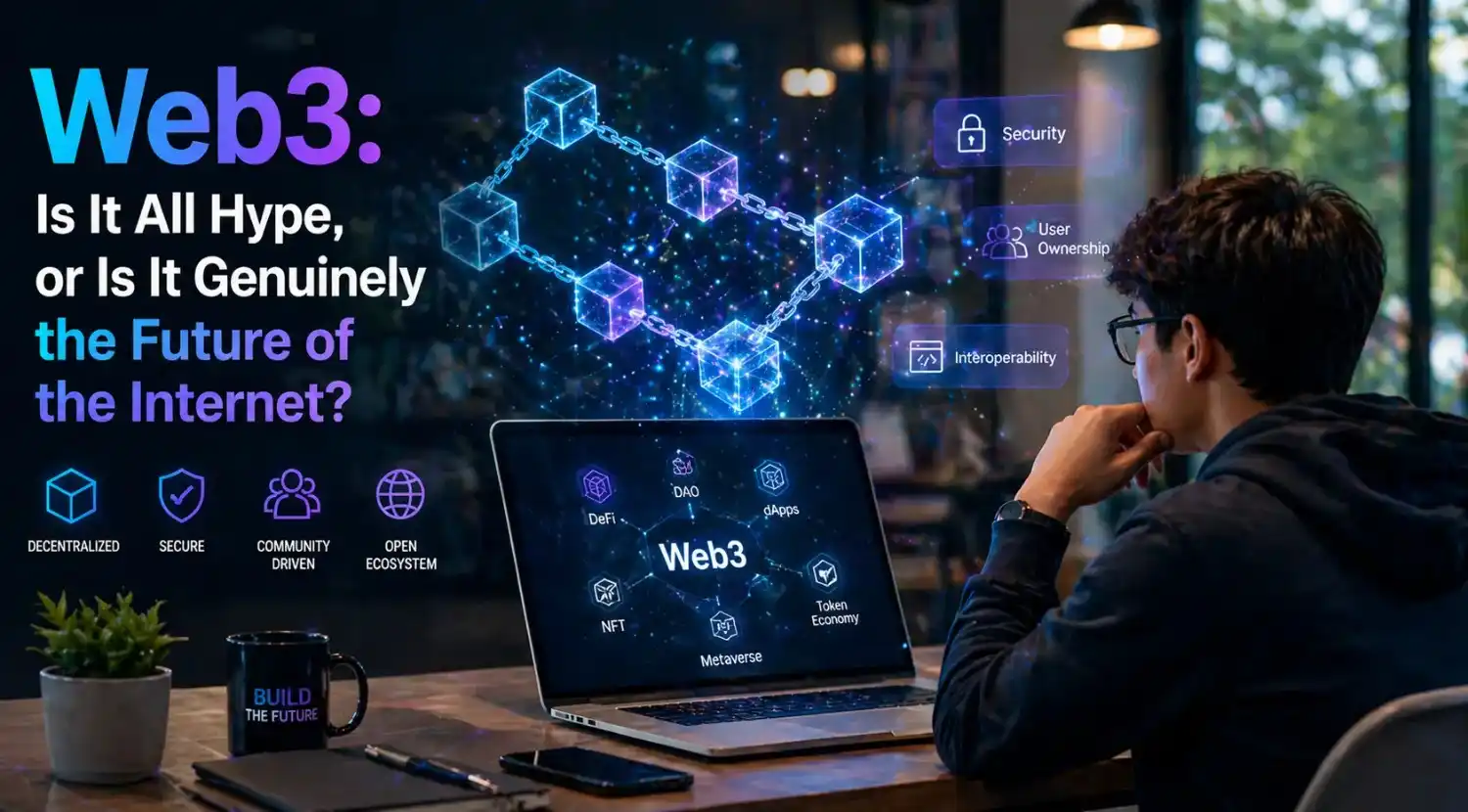
Web3 is the proposed next phase: a read-write-own internet built on blockchain technology, where users have genuine ownership of their data, their digital assets, and their online identities — without needing to trust a central platform to hold any of it for them. Instead of logging in with an email address managed by Google, you would authenticate with a cryptographic wallet that only you control. Instead of your content living on Facebook’s servers subject to Facebook’s rules, it would exist on a decentralized network that no single entity governs.
The three foundational principles are decentralization — removing the single points of control that currently dominate the internet; blockchain integration — using distributed ledgers to create transparent, tamper-proof records; and user ownership — giving individuals genuine control over their digital assets and identities.
These are meaningful ideas. The question is whether the execution has matched the vision.
The Hype Phase: What Went Wrong
Between 2020 and 2022, Web3 attracted an extraordinary amount of capital, attention, and speculation — and much of it was poorly directed.
NFTs — non-fungible tokens, which use blockchain to record ownership of digital items — became the dominant face of Web3 during this period. Digital artworks sold for millions of dollars. Profile picture collections became status symbols. The promise was that NFTs would revolutionize how creators owned and monetized their work.
What actually happened was that a significant portion of NFT activity was driven by speculation rather than genuine utility. People were not buying NFTs because they valued digital ownership as a concept — they were buying them because they expected to sell them for more later. When the speculative momentum reversed, prices collapsed and the mainstream perception of Web3 collapsed with them.
A similar pattern played out across many token-based projects. Protocols were launched not because they solved real problems but because they could attract liquidity. Projects were measured by wallet counts and token prices rather than by whether actual users found them genuinely useful. When easy capital became scarce, the projects that had been sustained by speculation rather than utility disappeared.
This is the version of Web3 that most people remember — and it is a fair reason for skepticism. But it is not the whole story.
What Web3 Has Actually Delivered
Strip away the speculation and the marketing, and there is a genuine technology underneath with real applications that are working right now.
Decentralized Finance (DeFi) is the most mature and substantive area of real Web3 deployment. DeFi platforms allow users anywhere in the world to lend, borrow, trade, and invest without going through a bank or a centralized financial institution. These platforms operate continuously, without geographic restrictions, and without requiring users to trust a single institution with their funds. For people in countries with unstable banking systems or limited access to financial services, DeFi represents a genuinely meaningful alternative. The total value locked in DeFi protocols runs into tens of billions of dollars — this is not theoretical; it is real money moving through decentralized systems daily.
Real-World Asset Tokenization is a more recent development that major financial institutions are now taking seriously. Tokenized real-world assets — government bonds, real estate, private credit, commodities — grew to over twenty-four billion dollars in total value by early 2026, representing extraordinary growth through 2025. Goldman Sachs and Fidelity are not experimenting with this concept anymore; they are integrating tokenized assets into regular operations. The infrastructure being built to bring real financial assets onto blockchain networks is serious, institutional-grade work.
Supply Chain and Enterprise Blockchain applications are functioning in the background of industries most people interact with every day. Walmart uses blockchain to trace food products — what would previously have taken days to investigate can now be traced in seconds. Pharmaceutical companies use blockchain to verify drug authenticity and prevent counterfeiting. These applications do not require users to know anything about Web3; they simply make existing systems more reliable and transparent.
Decentralized Physical Infrastructure Networks (DePIN) represent one of the more interesting emerging areas. Projects like Helium have used token incentives to build decentralized wireless networks. Render and similar projects provide decentralized computing power for AI and graphics workloads. The energy sector currently accounts for a significant portion of DePIN deployments. These are not speculative concepts — they represent real infrastructure being built and used.
The Real Problems That Still Exist
Acknowledging what Web3 has delivered does not mean ignoring its persistent and genuine problems.
Scalability remains the central technical challenge. Most major blockchain networks still struggle to handle large volumes of transactions without becoming slow and expensive. When transaction fees spike to the point where sending a small amount costs more than the amount itself, mainstream adoption becomes impossible. Progress is being made — layer-two solutions, modular blockchain architectures, and new consensus mechanisms are all addressing this problem — but it has not been fully solved.
User Experience is arguably the biggest barrier to adoption right now. Using a Web3 application as an ordinary person still requires understanding crypto wallets, private keys, seed phrases, gas fees, and transaction confirmation processes. The failure mode — losing your private key means losing your assets permanently, with no recovery option — is unforgiving in a way that no mainstream consumer technology can afford to be. Until interacting with Web3 applications feels as simple as using a standard app, mass adoption will remain out of reach.
Scams, Fraud, and Trust continue to undermine confidence in the space. The combination of irreversible transactions, pseudonymous actors, and regulatory gaps has made Web3 a fertile environment for fraud. Rug pulls — where developers abandon a project and disappear with investor funds — became distressingly common during the hype cycle. Recovering trust requires both better technical safeguards and clearer regulatory frameworks, both of which are still developing.
Centralization Creep is a philosophical problem that the space has not fully confronted. Many platforms that describe themselves as decentralized are, in practice, controlled by small groups of token holders, founding teams, or venture capital firms. The decentralization that Web3 promises is often more theoretical than operational.
Where Things Actually Stand in 2026
The most accurate description of Web3 in 2026 comes from the pattern of what has survived. The projects that have genuine users, real revenue, and actual utility are still operating and growing. The projects that were sustained purely by speculation have largely disappeared.
This consolidation is healthy, even if it is uncomfortable. As one analysis of the current state put it, Web3 in 2026 is smaller, quieter, and far more serious — and that is exactly why it is beginning to matter in ways the hype cycle never could. Investors are no longer funding ideas based on whitepapers and tokenomics diagrams alone. They are demanding proof of usage, evidence of retention, and realistic paths to adoption.
The convergence of Web3 and artificial intelligence is also creating new possibilities that did not exist during the original hype cycle. AI agents require verifiable identity, tamper-proof data, and permissionless payment systems to operate effectively across different platforms. Web3 infrastructure — particularly blockchain-based identity and payment systems — is well-positioned to provide exactly that. This convergence is not speculative; it is actively being built.
Regulatory clarity, while still incomplete, is improving. Governments and financial regulators in the European Union, the United States, and elsewhere have established clearer frameworks for how blockchain-based assets and platforms should be treated. Clearer rules reduce uncertainty, which in turn encourages more serious institutional participation and pushes out projects that relied on regulatory ambiguity to operate.
So — Hype or Future?
The honest answer is that Web3 was both overhyped and underestimated at the same time, in different ways.
It was overhyped as an immediate, total revolution — a complete replacement of the existing internet happening on a dramatic timeline. That version was always more marketing than substance, and the market correction that followed was deserved.
It was underestimated as a long-term infrastructure shift. The underlying technology — distributed ledgers, cryptographic ownership, smart contracts, decentralized finance — is real, is being used, and is being built upon by serious institutions and developers who are no longer interested in speculation.
The future of Web3 is unlikely to look like the sudden internet takeover its early advocates promised. It is more likely to look like a gradual integration into existing systems — often invisible to end users — that makes finance more accessible, ownership more verifiable, and digital infrastructure less dependent on single points of control and failure.
That is a less exciting story than the original pitch. But it is a more durable one.
What Should You Do With This Information?
You do not need to buy cryptocurrency or invest in Web3 projects to benefit from understanding where this technology is heading.
If you work in finance, logistics, healthcare, or any industry that deals with records, contracts, or ownership — pay attention to how blockchain is being integrated into enterprise systems in your sector. It is already happening in ways that will eventually reach your work.
If you are a developer or someone considering a career in technology, Web3 infrastructure — particularly the intersection of blockchain and AI — represents one of the more significant areas of genuine demand over the next five to ten years.
And if you are simply a curious person trying to make sense of the world, the key insight is this: the most transformative technologies rarely arrive the way they are first announced. The internet itself was dismissed, overhyped, crashed in 2001, and then quietly rebuilt the entire economy over the following two decades. Web3 may well follow a similar arc.
Conclusion
Web3 is not dead. It is not the revolutionary internet transformation that was promised in 2021. It is something more specific and more sustainable: a maturing technology ecosystem with real applications in finance, ownership, and infrastructure, burdened by a legacy of speculation and still facing genuine technical and usability challenges that must be solved before mainstream adoption becomes possible.
The hype was real. The crash was real. But so is the technology underneath — and that technology is quietly building the foundations of something that will eventually matter far more than the noise surrounding it ever did.