
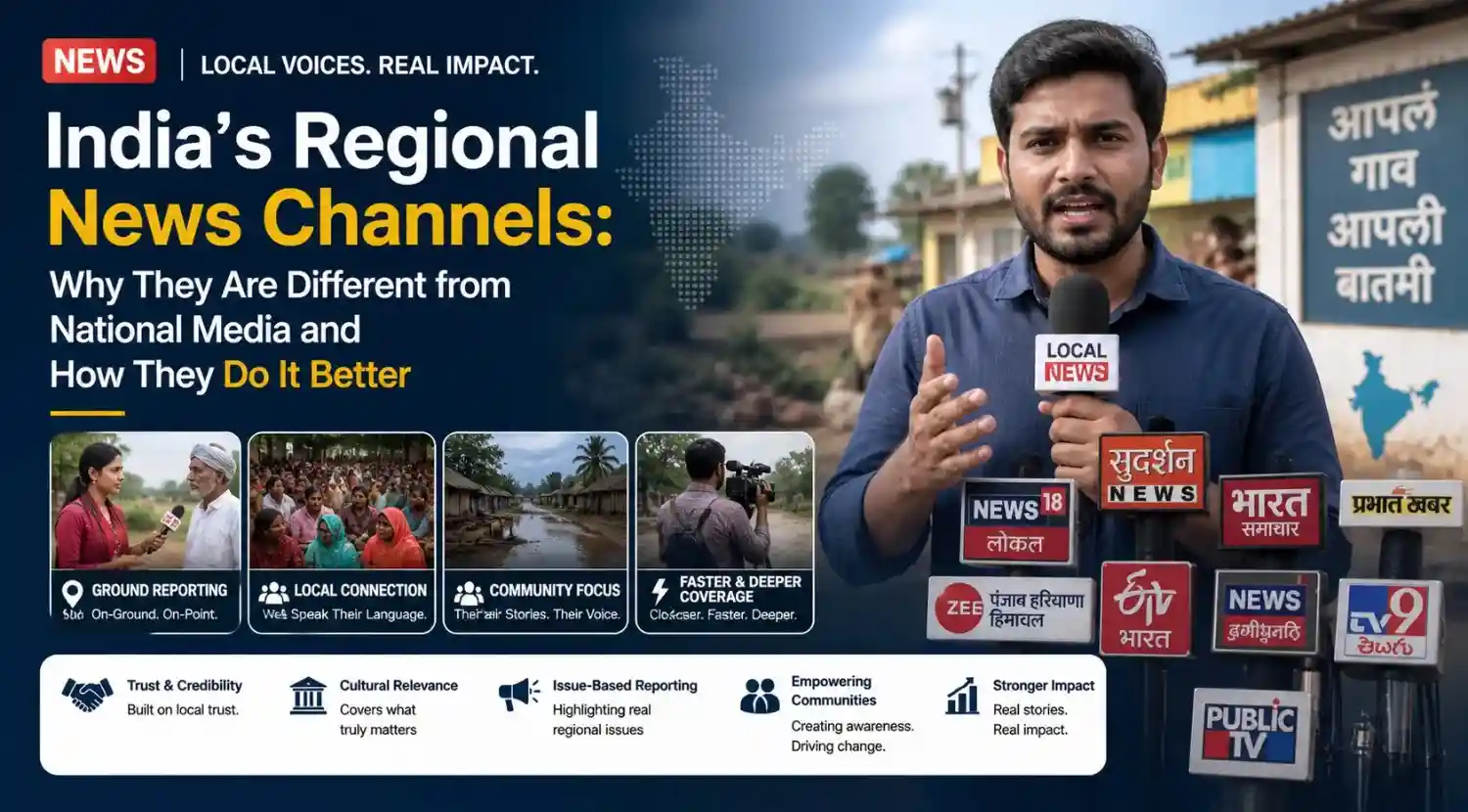
Introduction: The Two Indias of News
When a flood devastates a district in Assam, national news channels in Delhi may spend thirty seconds on it before cutting to a studio panel debating something else entirely. But Pratidin Time, a regional Assamese channel, will anchor its entire prime-time broadcast around it — with reporters on the ground, interviews with affected families, and follow-up coverage for days.
This isn’t an isolated example. It’s a structural reality of how India consumes news.
India is home to one of the world’s most complex media ecosystems. With 22 officially recognized languages, 28 states, and hundreds of distinct cultural identities, no single national news channel can authentically represent the whole country. This is precisely where India’s regional news channels step in — and why, in many ways, they do journalism better than their national counterparts.
The Scale of Regional News in India
India has over 900 satellite television news channels, the highest number for any country in the world. A significant majority of these are regional language channels. From Sun News in Tamil Nadu and TV9 Telugu in Andhra Pradesh to Eenadu TV, Asianet News in Kerala, and ABP Ananda in West Bengal, regional channels collectively reach hundreds of millions of viewers every single day.
According to the Broadcast Audience Research Council (BARC), regional language channels consistently dominate viewership ratings in their respective markets — often outperforming national Hindi and English news channels combined in those geographies. In southern states especially, regional channels are the primary — and often exclusive — source of news for the majority of the population.
The numbers tell a story that national media rarely acknowledges: India watches regional news, not the other way around.
What Makes Regional News Channels Different
1. Language Is Not Just a Medium — It’s a Message
The most obvious difference between regional and national channels is language. But this distinction runs far deeper than mere translation.
When a news anchor on Asianet News speaks in Malayalam, they aren’t simply translating a national story. They are framing it through a specific cultural, historical, and social lens that a Kerala viewer recognizes as their own. Idioms, references, and contexts that would be meaningless to a Delhi audience become instantly resonant.
National Hindi news channels often treat Hindi as a proxy for all of India — a form of linguistic hegemony that alienates over half the population. English news channels go further, catering to a thin urban elite. Regional channels break this hierarchy and place the viewer’s own language, voice, and world at the center of the news experience.
2. Hyper-Local Coverage That National Channels Simply Cannot Match
National channels operate on a principle of scale — they must select stories that matter to the broadest possible audience across the country. This inevitably means that local and regional issues get filtered out.
A panchayat election in rural Karnataka. A dam dispute between two talukas in Maharashtra. A fisherfolk protest in Puducherry. A teachers’ strike in Tripura. These stories are invisible to national media but are covered with depth and consistency by regional channels because they are the stories that actually affect the daily lives of viewers.
This hyper-local focus is not a limitation — it is a journalistic advantage. Regional reporters live in the communities they cover. They speak the language, know the local political landscape, and have sources built over years of trust. The quality of reporting that comes from this embedded relationship is something national media, parachuting in for one-off stories, simply cannot replicate.
3. Political Accountability at the State Level
One of the most important — and least discussed — functions of regional news channels is holding state governments accountable.
India’s federal structure means that enormous power lies with state governments: health, education, agriculture, police, land, and water are all primarily state subjects. Yet national media disproportionately focuses on the Central government and Parliament. State assemblies, chief ministers, and state-level bureaucracy receive far less scrutiny from national channels than they deserve.
Regional news channels fill this accountability gap. Channels like TV9 Kannada, Zee 24 Taas in Maharashtra, and News18 Tamil Nadu run sustained investigative series on state-level corruption, government scheme implementation failures, and local administrative lapses. This is journalism that directly impacts the lives of voters — and it happens consistently in the regional media space.
4. Cultural Context and Storytelling Traditions
Regional channels don’t just report news differently — they tell stories differently.
In Kerala, Asianet News is known for long-form documentary segments that explore social issues with a patience and depth rarely seen on national TV. In Tamil Nadu, channels weave political news into a cultural narrative that reflects the state’s unique Dravidian political identity. In West Bengal, ABP Ananda often contextualizes news within the state’s rich literary and intellectual traditions.
This cultural embeddedness makes regional news feel authentic rather than formulaic. Viewers don’t just receive information — they receive it in a way that feels like it belongs to their world.
5. Closer to the Ground During Crises
During natural disasters, communal tensions, or public health emergencies, regional channels consistently outperform national media in speed, depth, and accuracy of coverage.
During the Kerala floods of 2018, Asianet News ran a 24-hour live desk that coordinated rescue information for stranded residents. Viewers used the channel not just to watch the news but as a life-saving resource — with missing person details, water level updates, and rescue helplines broadcast in real time. No national channel came close to providing that level of community service.
Similarly, during COVID-19’s second wave, regional channels in states like Tamil Nadu and Maharashtra provided district-level hospital bed availability, oxygen supply updates, and vaccination camp information that was specific, accurate, and actionable — far more useful than the national coverage, which tended to focus on political debates.
The Challenges Regional Channels Face
Acknowledging regional media’s strengths does not mean ignoring its challenges.
Ownership concentration is a serious issue. Many regional channels are owned by business groups with political connections — Eenadu Group (TDP-affiliated), Sun Network (historically DMK-affiliated), and others. This can compromise editorial independence on sensitive political stories, much like the same problem plagues national channels.
Revenue pressures are intense. Regional channels operate in smaller advertising markets and often struggle with thin margins, leading to sensationalism, paid news practices, and a race to the bottom on production quality.
Digital transition is ongoing but uneven. While major regional channels have strong YouTube and OTT presence, many smaller regional players lack the resources to build digital infrastructure that matches the national players’ apps and streaming platforms.
And misinformation is a shared problem across all of Indian media — regional channels are not immune to viral falsehoods, especially in the WhatsApp-driven information environment of smaller towns.
The Digital Surge: Regional News Goes Online
The rise of YouTube and social media has been transformational for regional news.
Channels like TV9 Telugu, Puthiya Thalaimurai (Tamil), and Manorama News (Malayalam) have tens of millions of YouTube subscribers. Regional news content in Indian languages is among the fastest-growing video categories on the internet in India, driven by smartphone penetration in Tier 2 and Tier 3 cities and rural areas.
This digital surge has done something remarkable: it has made regional news accessible to the Indian diaspora around the world. A Malayali in Dubai, a Telugu speaker in New Jersey, or a Punjabi family in Canada can now stay connected to their home state’s news in real time. Regional channels have become cultural anchors for millions of Indians abroad.
What National Channels Can Learn From Regional Media
The success of regional news channels offers clear lessons for national media:
- Specificity beats generality. Viewers trust coverage that speaks directly to their reality.
- Language is identity. Respecting linguistic diversity is not a concession — it is a journalistic obligation.
- Local accountability matters. The stories that change people’s lives most often happen at the local and state level, not in Delhi.
- Community service builds loyalty. When news channels help viewers in moments of crisis, they earn long-term trust that no prime-time format can buy.
Conclusion: Regional Is Not Lesser — It’s Often Better
The assumption that national automatically means more credible, more sophisticated, or more important is one of the great myths of Indian media. For hundreds of millions of Indians, regional news channels are not the alternative to “real” news — they are the real news.
India’s linguistic, cultural, and geographic diversity is not a problem to be managed. It is the country’s defining characteristic. Regional news channels understand this. They have built journalism around this truth — and the results, at their best, represent some of the most grounded, relevant, and community-rooted reporting in the country.
In a media landscape increasingly dominated by noise, spectacle, and centralized narratives, regional news channels remind us what journalism is fundamentally supposed to do: serve the people who live where the news happens.