
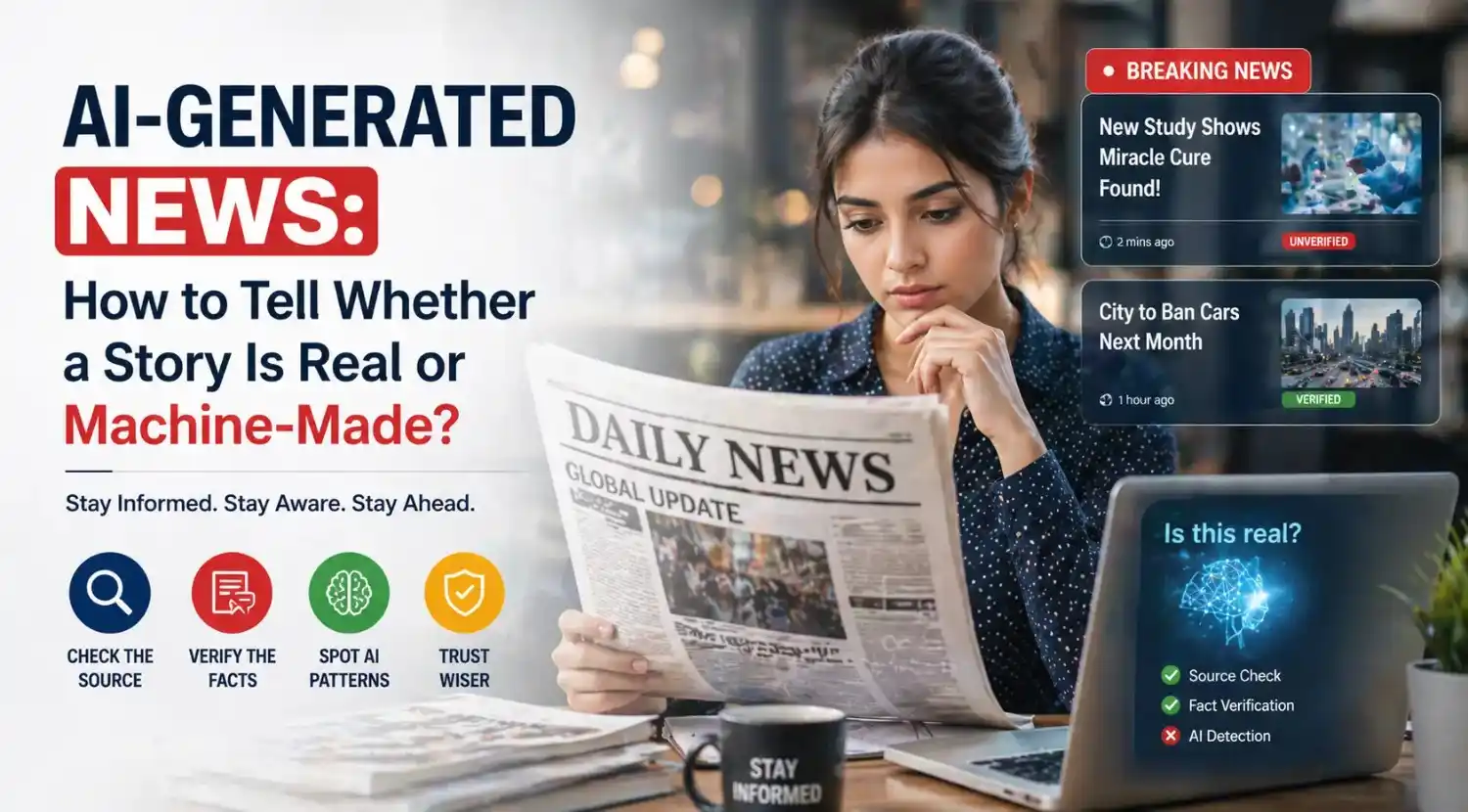
A few years ago, identifying a fake news article required some effort—usually spotting bad grammar, suspicious websites, or wildly unbelievable claims. In 2025, that’s no longer enough. AI tools can now produce news articles, social media posts, video scripts, deepfake images, and even synthetic voices that look and sound indistinguishable from professional journalism. Entire websites are being run almost entirely by AI, churning out hundreds of articles a day with no human reporter ever stepping foot near the events they describe.
This isn’t a future problem. It’s already here. From fake celebrity scandals to fabricated political quotes, from invented research findings to imaginary local news stories, AI-generated content is flooding the internet—and most readers can’t reliably tell the difference. The implications go far beyond clickbait. When you can’t trust what you read, your understanding of the world itself becomes shaky.
This article breaks down how AI-generated news actually works, why it’s so dangerous, and most importantly, the practical signals you can use to tell whether a story is real journalism or machine-made content.
The Rise of AI-Generated News Content
Generative AI tools have become powerful enough to produce news-style writing in seconds. Tools like ChatGPT, Claude, Gemini, and dozens of specialized text generators can take a basic prompt and produce a 600-word article that reads like it was written by a competent journalist. Add an AI image generator like Midjourney or DALL-E for the photo, an AI voice tool for narration, and you have a complete “news package” produced entirely without human reporting.
Some of this is legitimate. News organizations use AI to generate financial reports, sports recaps, weather summaries, and translations. Reuters, Associated Press, Bloomberg, and several Indian publications have been transparent about using AI-assisted writing for routine coverage. When done with editorial oversight, this is responsible automation.
The problem is the explosion of AI-generated content with no oversight at all. Researchers have identified hundreds of websites that masquerade as news outlets but publish AI-generated articles wholesale—often with no human editor, no fact-checking, and no real journalists. These sites exist for ad revenue, political manipulation, SEO traffic, or to spread coordinated disinformation. Many of them rank well on Google and get shared millions of times on social media before anyone realizes the source isn’t legitimate.
In short, the volume of synthetic news content online has exploded faster than our ability to identify it.
Why This Matters More Than Most People Realize
It’s tempting to dismiss this as just another internet annoyance. It’s not. AI-generated news has serious consequences for individuals, communities, and democracies.
When falsified articles are written convincingly, they shape public perception even after being debunked. Studies have repeatedly shown that corrections rarely reach the same audience as the original misinformation. Once a fake story has been read and shared by millions, its impact lingers regardless of whether it gets corrected later.
Political manipulation is another major concern. AI can produce thousands of articles, comments, and posts that all push a coordinated narrative. During elections, conflicts, and major policy debates, this kind of automated influence operation can sway public opinion at scale. Several countries have already seen documented cases of AI-driven disinformation campaigns affecting voter sentiment.
There’s also a personal financial dimension. AI-generated articles about stocks, cryptocurrencies, real estate, and health treatments can be designed to manipulate readers into bad decisions. People have lost money following investment “news” that was entirely fabricated by AI tools.
And there’s the broader epistemic crisis. When a meaningful portion of online news is synthetic, public trust in all news erodes—including legitimate journalism. People begin to assume everything could be fake, which is just as dangerous as believing everything is true.
Signal 1: Check the Source First, Always
The first and most important question to ask isn’t “is this article real?” It’s “where did this article come from?”
Established news organizations have public reputations, identifiable journalists, transparent ownership, and editorial standards. Even when they make mistakes, those mistakes are usually corrected publicly. Unknown websites with vague names, no clear ownership, no listed journalists, and no contact information should be treated with deep skepticism, regardless of how professional their articles look.
Look for the “About Us” page. Real news outlets typically list their editors, journalists, ownership structure, and editorial policies. AI content farms usually have generic, vague descriptions—”providing the latest news to readers worldwide”—with no specific people named.
Check whether the article has a named author with a real online footprint. Search the byline on LinkedIn, Twitter, or Google. Real journalists have careers, social profiles, and other articles they’ve written. AI content farms often use fake names, AI-generated headshots, or no author name at all.
If a story is breaking news on a major event, check whether reputable outlets like Reuters, AP, BBC, The Hindu, The Indian Express, NDTV, or PTI are also reporting it. If only obscure websites are carrying the story, it’s a major red flag.
Signal 2: Watch for the Telltale Patterns of AI Writing
AI-generated articles, even well-written ones, tend to share certain stylistic signatures. Once you know what to look for, you can spot many of them quickly.
AI writing often features overly smooth, generic prose. The sentences flow well, but there’s no distinct voice, no personality, no sharp observations, no quirks. Real journalism, even when it’s polished, usually has a recognizable human style.
Look for vague attributions. AI articles frequently use phrases like “experts say,” “sources suggest,” “studies have shown,” and “according to reports” without ever naming the actual experts, sources, or studies. Real journalism cites specific people, specific publications, and specific reports.
AI tends to repeat itself in slightly different words. Watch for paragraphs that essentially restate the same information using synonyms—a hallmark of language model output trying to fill space.
The structure is often suspiciously balanced. AI articles tend to have neat introductions, perfectly proportioned middle sections with three or four points, and tidy conclusions that summarize what was just said. Real news writing is rarely that symmetric.
Many AI articles include lists of generic “tips” or “things to know” that read like they could apply to almost any situation. Specific, situational advice is harder to fake; general filler is easy.
Watch for factual claims that are plausible but oddly hard to verify. AI has a well-known tendency to “hallucinate”—making up statistics, quotes, names, events, and citations that sound real but don’t exist.
Signal 3: Verify Specific Facts, Quotes, and Numbers
This is where most AI-generated content falls apart on closer inspection.
When an article cites a quote from a public figure, search that exact quote. Real quotes from real people are usually available on multiple legitimate sources—a press conference, a previous article, an official statement. If the quote appears only on one obscure website, it might be fabricated.
Statistics and data points should be traceable. If an article says “according to a 2024 study by Stanford University,” try to find that study. AI commonly invents official-sounding sources that don’t actually exist.
Names of organizations, reports, books, and experts can also be invented. A quick Google search of a cited expert often reveals whether they’re a real person with credentials in that field.
Pay particular attention to proper nouns—dates, names, places, institutions. AI hallucinations cluster around these specific details because the model is filling them in based on patterns rather than actual knowledge.
Signal 4: Examine the Images and Videos Carefully
Text isn’t the only AI-generated content in modern news. Images and videos are increasingly synthetic too, and they can be even more convincing than text.
Look at people’s hands, ears, eyes, and teeth in photographs. AI image generators still struggle with these details, often producing extra fingers, asymmetric features, or oddly shaped jewelry and accessories. Hair, especially fine details, can look painted rather than photographed.
Backgrounds in AI images often have small inconsistencies—text that doesn’t quite spell anything, signs that are warped, reflections that don’t match, lighting that doesn’t behave realistically.
For breaking news photos, check whether the image appears in reverse image searches on Google, TinEye, or Yandex. If the only place it appears is the article you’re reading, that’s suspicious. Real news photos are usually distributed by news agencies and appear on multiple legitimate sites.
Videos require even more scrutiny. Deepfake technology has advanced rapidly, but most synthetic videos still show small artifacts—unnatural blinking, slight mouth-audio mismatch, strange skin texture in close-up, hair that doesn’t move naturally, or background elements that flicker. Watch the video carefully and pause frequently.
If a video shows a famous person saying something controversial, ask yourself: have any major news outlets reported on this statement? If a global figure made shocking comments, it would be major news everywhere within hours.
Signal 5: Check the Date, Updates, and Context
Real news articles get updated as stories develop. They include publication dates, “last updated” timestamps, and corrections when needed. AI-generated content is often static—published once and never touched again.
Be cautious of articles with no clear publication date, or with dates that seem oddly precise but don’t match any real event timeline. AI farms sometimes recycle old stories with new dates to make them look fresh.
Check if the article’s claims match the broader news context. Is the event being covered actually happening, or is it just one website’s claim? If a major political development supposedly happened, multiple legitimate outlets should be covering it within hours.
For health, finance, and science topics, check whether the underlying claims are supported by actual peer-reviewed research, official agencies, or recognized authorities. AI articles love to cite vague “studies” without linking to them.
Signal 6: Use Available Detection Tools
Several tools can now help detect AI-generated content, though none are perfect.
For text, tools like GPTZero, Originality.ai, Copyleaks, and Turnitin’s AI detection can flag content that’s likely AI-generated. They’re not foolproof—they produce false positives and false negatives—but they’re useful as a second opinion. Use them as one input, not the final verdict.
For images, tools like Hive Moderation, Google’s reverse image search, and AI Image Detector can help spot synthetic visuals.
For videos, deepfake detection is harder, but tools like Deepware Scanner, Reality Defender, and Microsoft’s Video Authenticator are improving.
Browser extensions like NewsGuard rate news websites for credibility based on transparency, accuracy, and accountability standards. They give you a quick visual indicator of whether a source is trustworthy.
Be aware that detection tools always lag behind generation tools. As AI gets better at producing realistic content, detection becomes harder. Don’t rely on tools alone—combine them with your own judgment.
Signal 7: Trust Your Instincts and Slow Down
The most underrated tool you have is your own pause button. Most misinformation spreads because people share it impulsively without verifying.
Before sharing or believing an article, ask yourself a few questions. Does this story confirm something I already wanted to believe? (Confirmation bias makes us less critical.) Is the headline designed to provoke an emotional reaction—anger, fear, outrage? (Sensational stories deserve extra scrutiny.) Does the article ask me to share it urgently? (Urgency is a manipulation tactic.) Is the source one I would normally trust, or does it just happen to be saying what I want to hear?
If something feels off, it probably is. Take 60 seconds to verify before sharing.
How Newsrooms and Platforms Are Responding
The good news is that the fight against AI-generated misinformation isn’t one-sided. News organizations are investing in fact-checking units, AI-detection partnerships, and source-verification protocols. Major platforms like Google, Meta, and YouTube are working on labels for AI-generated content, although enforcement remains inconsistent.
Some publishers have started displaying transparency labels: “This article was generated with AI assistance and reviewed by a human editor.” This kind of disclosure helps readers make informed judgments. Regulations are also evolving—the EU has passed AI Act provisions that require certain forms of AI content to be labeled, and other regions are following.
Still, the responsibility ultimately falls on individual readers. Platforms move too slowly to catch every fake story, and bad actors will always find ways to bypass restrictions. Personal media literacy is the most reliable defense.
Building Your Personal Anti-Misinformation Habits
A few habits can dramatically improve your ability to navigate the AI-saturated news environment.
Build a small list of trusted news sources and start there before exploring further. Reading a story directly from a reputable outlet is safer than seeing it shared on social media.
Cross-check important claims with at least two independent sources before believing or sharing them. If a story only exists on one obscure site, it probably shouldn’t be trusted.
Be especially cautious during breaking news events. The first hours of any major story are full of misinformation, both human-spread and AI-generated. Wait for verified reporting before forming strong opinions.
Follow professional fact-checking organizations like Alt News, BOOM, Vishvas News, FactChecker.in, and international ones like Snopes and Reuters Fact Check. They debunk viral misinformation regularly.
Educate the people around you. Many older family members and less internet-savvy friends are particularly vulnerable to AI-generated content. Sharing what you’ve learned helps everyone.
Final Thoughts
AI-generated news is one of the defining information challenges of our time. The technology will keep improving, the volume will keep growing, and the lines between human-written and machine-made content will keep blurring. There is no single trick that will let you spot every fake story. The best defense is a combination of skepticism, verification, source awareness, and slow thinking.
The good news is that the same critical thinking skills that help you navigate AI-generated content also make you a sharper consumer of all news, including human-written content. When you build the habit of asking who wrote this, where the facts come from, and whether the claims are verifiable, you become harder to fool by anyone—human or machine.
The internet of 2025 rewards the patient, the curious, and the careful. In a world where anyone can produce content that looks authoritative, your judgment is the most valuable filter you have. Use it well.