
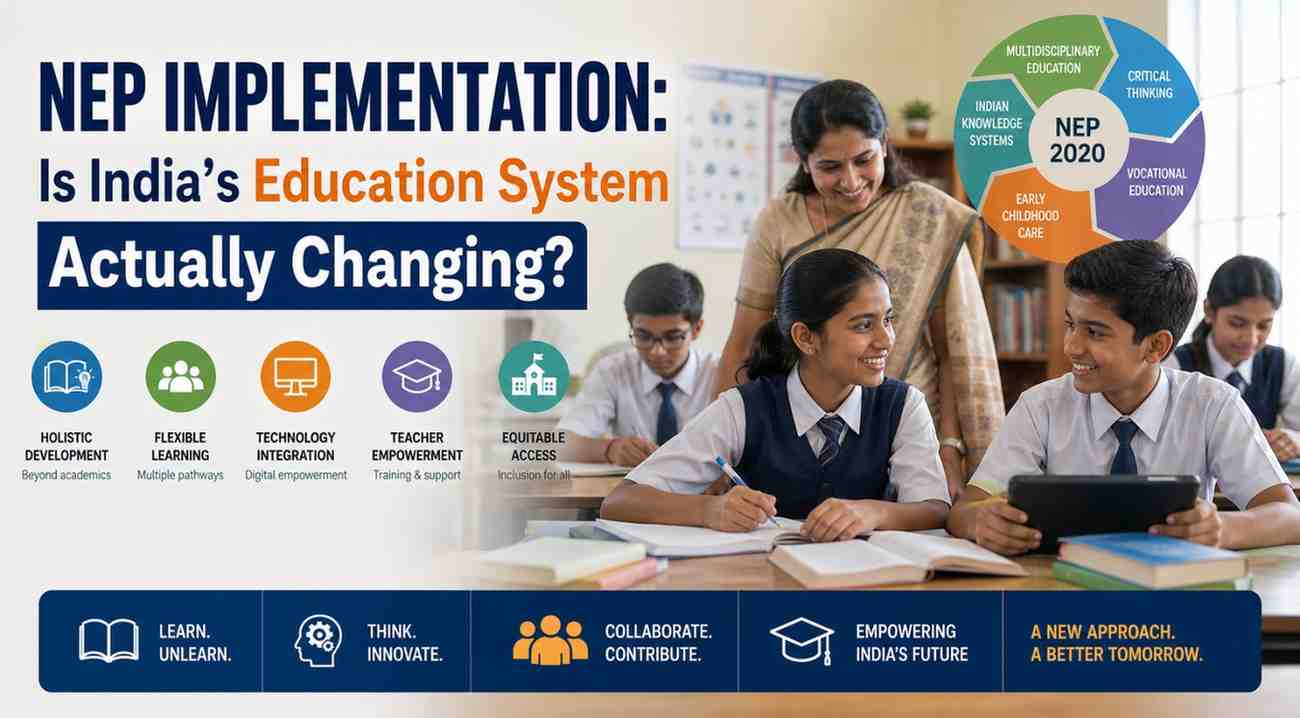
When the National Education Policy 2020 was unveiled in July 2020, it was hailed as the most ambitious overhaul of India’s education system in 34 years. Replacing the outdated 1986 policy, NEP 2020 promised sweeping changes—a new 5+3+3+4 school structure, mother tongue as the medium of instruction in early grades, multidisciplinary higher education, multiple entry and exit points, vocational training from Class 6, and a roadmap to make India a global education hub by 2040.
Five years on, the questions are getting harder to dodge. Has any of this actually happened in classrooms across India? Are children really learning in their mother tongue? Are colleges actually offering four-year flexible degrees with credit transfers? Or has NEP 2020 mostly remained a beautifully written document while the on-ground reality stays stuck in old habits?
This article cuts through the rhetoric on both sides and examines what NEP 2020 has actually delivered, where it has stalled, and what its real impact has been on India’s education system as of 2025.
A Quick Recap: What NEP 2020 Promised
Before evaluating progress, it’s worth recalling what NEP 2020 set out to achieve. The policy proposed a fundamental restructuring of education across multiple dimensions.
The school structure was to change from the long-standing 10+2 model to a 5+3+3+4 system. This meant five years of foundational education (ages 3-8), three years of preparatory (8-11), three years of middle (11-14), and four years of secondary (14-18). Early childhood education was to be formally integrated into the system for the first time.
Foundational literacy and numeracy for every child by Grade 3 was set as the highest priority through the NIPUN Bharat mission. Mother tongue or regional language was recommended as the medium of instruction up to Grade 5, ideally up to Grade 8. The rigid separation of arts, science, and commerce streams was to dissolve, allowing students to mix subjects.
In higher education, the policy called for four-year undergraduate programs with multiple entry and exit options, an Academic Bank of Credits (ABC) for credit storage and transfer, the merging of regulatory bodies into a single Higher Education Commission of India (HECI), expansion of multidisciplinary universities, and a target of 50% Gross Enrolment Ratio in higher education by 2035.
Vocational education was to begin from Class 6, including hands-on internships. Education spending was to rise to 6% of GDP. Technology integration through DIKSHA, SWAYAM, and PM eVIDYA was to bridge access gaps.
It was, on paper, a transformational vision. So how much of it has actually happened?
Where Real Change Has Happened
To be fair, NEP 2020 has produced meaningful progress on several fronts. Dismissing it as “just a document” would be inaccurate.
School Structure Rollout
The 5+3+3+4 structure is being adopted in waves. Reports indicate that around 67% of schools have adopted the new curricular structure, replacing the traditional 10+2 system. States like Maharashtra, Madhya Pradesh, Uttarakhand, Karnataka, and Delhi are leading the rollout, and the Maharashtra government confirmed full school-level implementation from June 2025. Over 10,000 schools are now operating under the new structure as part of central rollout plans.
The National Curriculum Framework for School Education (NCF-SE) 2023 has translated the policy’s pedagogical vision into actual curriculum design, providing a tangible roadmap for textbooks and teaching practices.
Foundational Literacy Push
The NIPUN Bharat Mission, launched in 2021, focuses on universal foundational literacy and numeracy by Grade 3. ASER 2024 reports note improvements in foundational learning outcomes for the first time in years, with credit being given to systemic national efforts. While the goal of universal foundational literacy by 2025 has not been fully met, the trajectory is finally moving in the right direction after years of stagnation.
Digital Infrastructure
Platforms like DIKSHA, SWAYAM, PM eVIDYA, and Vidya Samiksha Kendras (VSKs) have become genuine pillars of NEP implementation. DIKSHA and SWAYAM together aim to serve over 15 crore students. Around 15,000 schools have started using AI-powered adaptive learning platforms. About 74% of examinations in many systems are now conducted through online proctored modes. The National Digital University was launched in early 2025, adding another layer to digital education access.
Higher Education Reforms in Motion
The Four-Year Undergraduate Program (FYUP) and Academic Bank of Credits are now operational in central universities and many state institutions. CUET (Common University Entrance Test) is now being implemented across roughly 90% of central universities, standardizing admissions in a way that wasn’t possible before.
Research output from India has surged about 88% since 2015, India’s Global Innovation Index rank has risen from 76 in 2014 to 39 in 2025, and 11 Indian universities now feature in the QS World Top 500. While not all of this is attributable to NEP, the policy’s emphasis on research and internationalization has clearly contributed.
Indian Knowledge Systems and Multilingualism
Indian Knowledge Systems (IKS) are being introduced in curricula from Grade 3 onwards. Instruction is now available in 22+ languages under the three-language formula. JNU and other central universities have established new centers for traditional Indian studies. Teacher training under NISHTHA has reached around 3.2 million teachers in digital literacy and pedagogy.
Skilling and Innovation
Coding, multidisciplinary learning, and over 10,000 Atal Tinkering Labs have been rolled out, with plans for 50,000 more. Vocational integration from Grade 6 is being piloted across multiple states, with 50+ skill tracks now available.
Where Implementation Is Lagging
The progress is real, but so are the gaps. Pretending otherwise would do disservice to the millions of students still affected by half-implemented reforms.
Higher Education Commission Hasn’t Happened
One of NEP’s biggest structural reforms—the establishment of the Higher Education Commission of India (HECI) to replace UGC, AICTE, and NCTE—has been stuck. HECI requires an Act of Parliament, and there’s no clear timeline yet. As long as multiple regulatory bodies continue to operate with overlapping jurisdictions, the deeper reforms NEP envisaged in higher education can’t fully take shape.
Teacher Training Is the Weakest Link
Almost every independent assessment points to the same problem: teachers haven’t been adequately trained to deliver NEP’s vision. ASER 2024 specifically flagged that classroom teaching remains syllabus-driven rather than focused on foundational learning, contradicting the policy’s core goals. Many teachers report that they were handed new curricula without proper orientation, leading to confusion and superficial implementation. Until India invests massively in teacher training and continuous professional development, the policy’s classroom-level impact will remain limited.
Funding Remains a Major Constraint
NEP 2020 promised to raise public education spending to 6% of GDP. Five years in, India is still around 3% of GDP—where it has been for decades. Without a meaningful jump in funding, ambitions like universal early childhood education, foundational literacy, and infrastructure modernization simply cannot be delivered at scale.
Federal Friction and Political Resistance
Education is a Concurrent List subject in India, meaning both the Centre and states have authority. Several states have resisted parts of NEP. Tamil Nadu has rejected the three-language formula entirely. Karnataka’s Congress-led government has taken steps to amend NEP implementation after originally being the first state to adopt it. Kerala and West Bengal have moved cautiously. Without state-level buy-in, large parts of NEP cannot actually reach classrooms.
Rural-Urban Divide and Digital Gap
Much of the digital infrastructure of NEP—online learning, AI tutoring, digital assessments—is concentrated in urban and semi-urban areas. Schools in remote rural blocks still lack reliable electricity, internet, and devices. The gap between what’s possible in a Mumbai or Bengaluru school and what’s possible in a tribal village school is widening, not narrowing. This contradicts NEP’s core promise of equitable access.
Higher Education Implementation Is Uneven
While central universities have largely adopted FYUP and ABC, many state universities are still figuring out the basics. Reports from West Bengal, Bihar, and several other states indicate slow and uneven rollout. Colleges complain that they’re being asked to adopt new structures without the additional faculty, infrastructure, or budget needed to support them. Some institutions report that the new diversified course load has actually worsened teaching quality due to overload.
Critics Point to Centralization Concerns
Several scholars and educationists have argued that NEP 2020 was hurried in its initial drafting, with limited public consultation. The Central Advisory Board on Education (CABE), which traditionally serves as a deliberative platform between Centre and states, has been inactive for long stretches. Critics argue that important curricular decisions—including expanded IKS content—are being shaped without sufficient debate, raising concerns about both quality and ideological influence.
Out-of-School Children Targets Unmet
NEP set ambitious targets for bringing 2 crore out-of-school children back into the system. Updated progress data is limited, and several reports suggest that the goal remains far from being met, particularly among migrant communities, urban slums, and tribal regions.
What’s Actually Changing in Classrooms
Beyond policy documents and macro statistics, what does the average Indian student or teacher actually experience differently in 2025 compared to 2020?
In some classrooms—especially in PM SHRI Schools, central government schools, and progressive private schools—there are visible changes. Earlier introduction of formal play-based learning. More flexibility in subject choices at the senior secondary level. Greater use of digital tools. More project work and competency-based assessments. More vocational exposure.
In many other classrooms—particularly in under-resourced government schools across rural India—the daily experience hasn’t changed all that much. Same overcrowded classrooms, same overworked teachers, same textbook-driven teaching, same examination pressure. The policy’s vision hasn’t yet reached these students in any meaningful way.
This is the central tension of NEP 2020 implementation. The reform is real, but uneven. Some children are getting the future of Indian education; others are still living in its past.
A Balanced Verdict at the 5-Year Mark
So is India’s education system actually changing? The honest answer is: yes, but partially, and unevenly.
NEP 2020 is not a paper tiger. Real structural changes are happening—new school stages, new curriculum frameworks, new digital platforms, new degree formats, new admissions systems, new teacher training initiatives. India’s education system in 2025 looks meaningfully different from where it was in 2020.
But the policy is also far from delivering its full promise. Teacher training, funding, federal coordination, rural-urban equity, and higher education governance remain major bottlenecks. Without serious progress on these, NEP risks becoming a story of brilliant ambition partially realized.
The next five years will determine whether NEP 2020 becomes a transformational chapter in Indian education history or a half-implemented reform that future policymakers will need to rescue. The full vision is targeted for 2030 (school education) and 2035 (higher education GER targets), with a longer horizon stretching to 2047. Whether India hits those targets depends on choices made now—in budget allocations, teacher development, state coordination, and political will.
What Parents and Students Should Do in This Transition
For families navigating this in-between period, here’s some practical perspective.
Don’t assume the school you’re choosing is fully NEP-aligned just because of marketing claims. Ask specific questions: Has the school adopted the 5+3+3+4 structure? Are teachers trained for competency-based assessments? Is mother tongue genuinely supported in early grades? Are vocational and skill-based components actually being taught?
Recognize that flexibility in higher education is real and growing. Multiple entry and exit options, FYUP, and credit transfers are now available, especially in central universities. Plan academic decisions with these new options in mind.
Continue to invest in skills outside the formal system. Whether NEP succeeds or stalls, the future job market will reward demonstrable skills—coding, design, communication, critical thinking, languages. Don’t wait for the school system to deliver these.
Stay informed. Education policy is evolving rapidly, and what’s true in 2025 may shift by 2028. Follow credible education news sources, attend parent-teacher meetings, and engage with how your child’s school is interpreting NEP.
Final Thoughts
NEP 2020 is the most significant attempt to reshape Indian education in a generation. Five years in, it has produced visible progress—new structures, new technologies, new flexibilities, new ambitions—alongside very real failures of execution, funding, and coordination. India’s education system is changing, but slowly, unevenly, and with a long road ahead.
The question is no longer whether NEP 2020 has impact. It clearly does. The real question is whether the country—governments, teachers, parents, students, and institutions—can sustain the political will, financial commitment, and operational discipline needed to translate vision into reality at scale. The promise of NEP 2020 is genuinely powerful. Whether India delivers on it will define the educational lives of an entire generation of children.
That’s a story still being written.