Most people have heard the phrase “quantum computing” at least once in the past year. It appears in technology headlines, government policy announcements, and conversations about the future of artificial intelligence. And yet, for the vast majority of people, it remains something abstract — a vaguely impressive concept that seems to belong to physicists and Silicon Valley engineers, not ordinary life.
That perception is about to become a problem. Because quantum computing is no longer a distant theoretical idea. It is being built right now, it will affect your life within this decade, and understanding at least the basics of what it is and why it matters has become genuinely useful knowledge.
This article will explain quantum computing in plain language — no physics degree required — and tell you exactly why it matters for your health, your financial security, your data, and the technology you use every day.
What Is a Classical Computer, and Why Does It Matter?
Before you can understand quantum computing, you need a clear picture of how the computers you already use actually work.
Every device you own — your smartphone, your laptop, your smart TV — is a classical computer. At the most fundamental level, all of these machines process information using something called a “bit.” A bit is the smallest unit of data, and it can hold exactly one of two values: zero or one. Think of it like a light switch. It is either off, representing zero, or on, representing one.
Everything your computer does — displaying a webpage, playing a video, sending a message, running an application — is ultimately the result of billions of these switches flipping on and off in precise sequences. The power of modern computers comes not from any single switch being clever, but from billions of them working together at extraordinary speed.
This system has served humanity remarkably well for decades. But it has a fundamental ceiling. There are certain categories of problems — simulating molecular behavior, optimizing enormously complex systems, cracking advanced encryption — where classical computers simply run out of road. No matter how fast you make them, no matter how many processors you add, these problems remain computationally out of reach.
That is the gap quantum computing is designed to fill.
What Makes Quantum Computing Different?
A quantum computer does not use bits. It uses “qubits” — quantum bits — and qubits operate according to the rules of quantum mechanics rather than classical physics.
Here is where most explanations get unnecessarily complicated. Let us keep it simple.
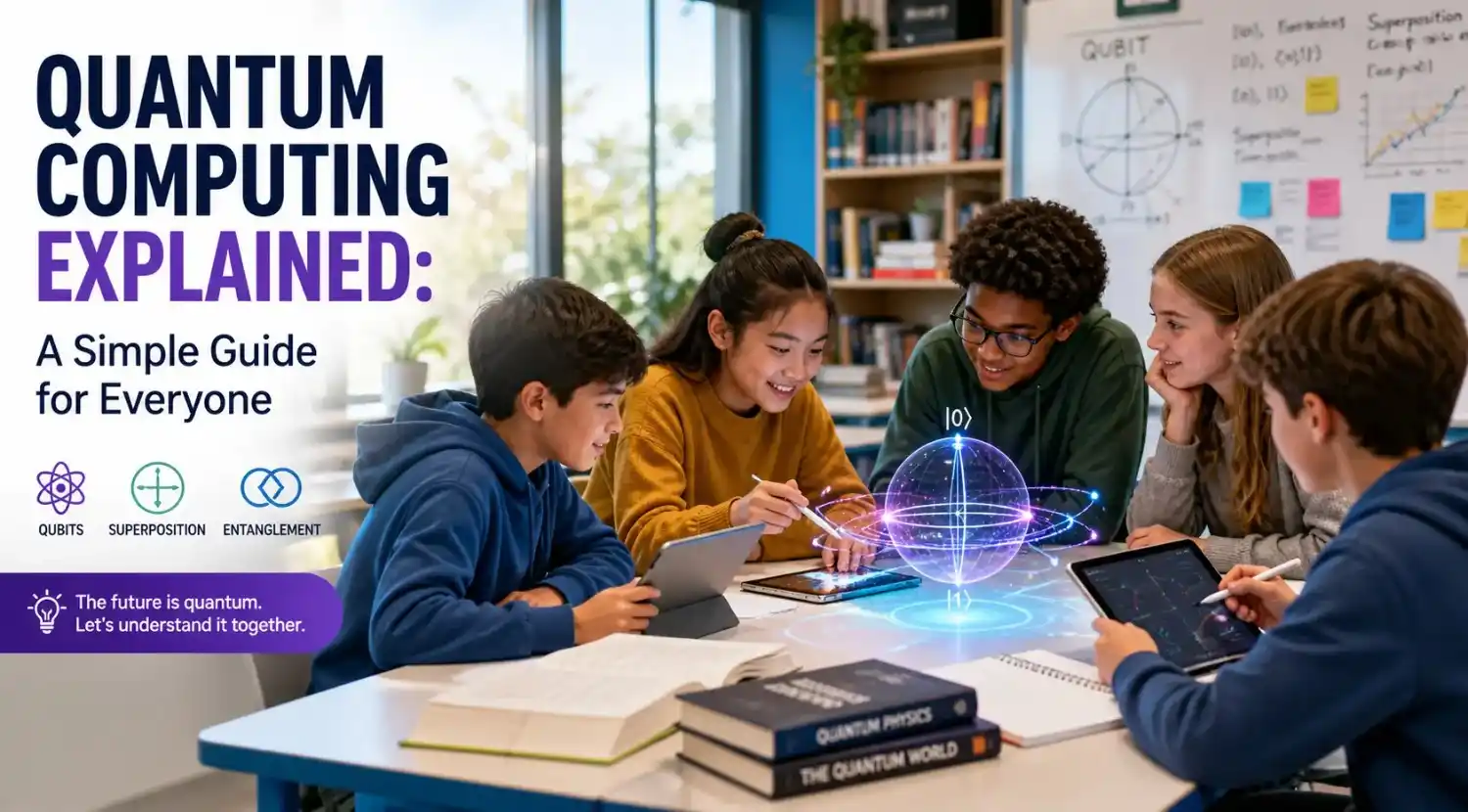
A classical bit is always either zero or one. A qubit can be zero, it can be one, or it can be both at the same time. This property — existing in multiple states simultaneously — is called superposition. It sounds strange because it is strange. Quantum mechanics describes a world that behaves very differently from the everyday world we experience. But the practical implication is straightforward: a qubit carries far more information than a classical bit, and a quantum computer can explore an enormous number of possibilities at the same time rather than one after another.
There is a second property that makes qubits even more powerful, called entanglement. When two qubits are entangled, the state of one instantly influences the state of the other, regardless of the physical distance between them. This allows quantum computers to coordinate calculations across multiple qubits in ways that have no equivalent in classical computing.
The result is a machine that approaches certain kinds of problems in a fundamentally different way — not faster in the simple sense of doing the same thing more quickly, but structurally different in the way it finds answers.
A Simple Analogy That Actually Works
Imagine you are searching for a specific name in a physical phone book with ten thousand entries. A classical computer works through this problem sequentially — checking the first entry, then the second, then the third, working its way through until it finds the name. Even at extraordinary speeds, it is still a one-at-a-time process at its core.
A quantum computer, thanks to superposition, can evaluate all ten thousand entries simultaneously. It does not check them one by one. It considers the entire space of possibilities at once and converges on the answer in a way that is qualitatively different from anything classical computing can do.
This analogy is imperfect — all analogies for quantum mechanics are — but it captures the essential point: quantum computing is not just faster, it is a different approach to problem-solving altogether.
Why Should an Ordinary Person Care?
This is the most important question, and the answer is more immediate than most people realize.
Your health. Drug discovery is one of the most complex computational challenges in existence. To develop a new medicine, researchers must understand how molecules interact with each other at an atomic level — a process involving calculations of staggering complexity. Classical computers can approximate these interactions but cannot model them with true precision. A single molecule simulation that would take a classical supercomputer thousands of years can theoretically be completed by a sufficiently advanced quantum computer in hours. The implication is enormous: diseases that currently have no treatment, conditions that require decades of research to address, could see their timelines compressed dramatically. Quantum computing will not cure cancer overnight, but it will fundamentally accelerate the pace at which new treatments are discovered.
Your financial security. The encryption protecting your bank account, your email, your medical records, and virtually every secure digital transaction in the world today is based on a mathematical problem — the factoring of very large numbers — that classical computers cannot solve in any practical amount of time. Quantum computers, using an algorithm called Shor’s algorithm, will eventually be able to break this encryption. This is not a hypothetical concern. Governments and institutions around the world are actively working to develop quantum-safe cryptography right now, precisely because they know this moment is approaching. What this means for you is that the security infrastructure of the internet will undergo its most significant transformation in decades within the next ten to fifteen years.
The AI tools you already use. Artificial intelligence and quantum computing are deeply connected. Quantum algorithms can identify patterns in complex datasets that are invisible to classical systems, optimize neural networks more efficiently, and dramatically accelerate the training of AI models. The AI tools that are already part of your daily life — voice assistants, recommendation systems, search engines, translation tools — will become meaningfully more capable as quantum computing matures.
Climate and environment. Some of the most important unsolved problems in climate science are also computational problems. Modeling the behavior of the atmosphere, optimizing renewable energy grids, designing more efficient solar cells, understanding ocean current patterns — these require simulations of complex systems that exceed what classical computers can handle. Quantum computing has the potential to accelerate progress on climate solutions in ways that are difficult to overstate.
Where Are We Right Now?
It is worth being honest about the current state of quantum computing, because the gap between the technology’s potential and its present reality is significant.
IBM and Google have both made landmark progress in recent years. Google’s error-corrected qubits and IBM’s Qiskit framework have moved quantum computing closer to practical stability — one of the central engineering challenges in the field is keeping qubits coherent long enough to complete useful calculations, since they are extraordinarily sensitive to environmental interference.
In 2025, quantum computing is genuinely useful for a narrow but growing range of research applications. It is not yet a mainstream commercial technology. A quantum computer in your home is likely fifteen to twenty years away. But quantum computing as a service — accessed remotely through cloud platforms — is already available to researchers and companies today.
The effects will reach ordinary people not through direct contact with quantum machines, but through the products and systems those machines make possible: faster drug approvals, more secure digital infrastructure, more powerful AI, better climate models.
How Is the World Responding?
The global response to quantum computing reflects how seriously governments and industries take its implications. The United States, China, the European Union, India, and the United Kingdom have all launched national quantum initiatives with billions in public funding. Major technology companies including IBM, Google, Microsoft, and Amazon have active quantum computing divisions. A thriving ecosystem of quantum computing startups is emerging worldwide.
India launched its National Quantum Mission in 2023 with a budget of over six thousand crore rupees, targeting the development of quantum computers with increasing qubit counts over the next eight years. This positions India as a meaningful player in a technology race that will have significant geopolitical and economic consequences.
What Should You Actually Do With This Information?
You do not need to become a quantum physicist. But there are a few practical things worth taking away from this.
First, if you work in a field that involves data security — finance, healthcare, law, government — pay attention to developments in post-quantum cryptography. The transition to quantum-safe security standards will affect your organization, and awareness now is better than being caught unprepared.
Second, if you are a student or early-career professional considering where to build expertise, quantum computing and quantum-adjacent fields represent one of the most significant areas of demand growth over the next two decades. Physics, mathematics, computer science, and materials science all feed into this space.
Third, and most broadly: stay curious. The most important thing about quantum computing for an ordinary person is not the technical details but the awareness that a genuinely new kind of capability is being added to the human toolkit — one that will reshape medicine, security, energy, and intelligence in ways that will touch everyone.
Conclusion
Quantum computing is not magic, and it is not science fiction. It is a real, developing technology built on genuine physics, being advanced by thousands of researchers around the world, and approaching a threshold of practical impact that will arrive within your lifetime — and for many applications, within this decade.
The core idea is simple: where classical computers process information one possibility at a time, quantum computers can process many possibilities simultaneously. That difference, applied to the right problems, changes everything.
You do not need to understand the mathematics of superposition or entanglement to benefit from what is coming. But understanding that it is coming, and roughly why it matters, puts you ahead of most people — and that is always a useful place to be.